Business Security
Cybersecurity Solutions for Business (2026): The Complete Buyer's Guide to Tools, Frameworks & Managed Services
A no-fluff 2026 guide to cybersecurity solutions for business — what to buy, in what order, at what price, and how to align it all to the NIST Cybersecurity Framework 2.0. Written by Cybrvault engineers who deploy this stack for Miami businesses every week.
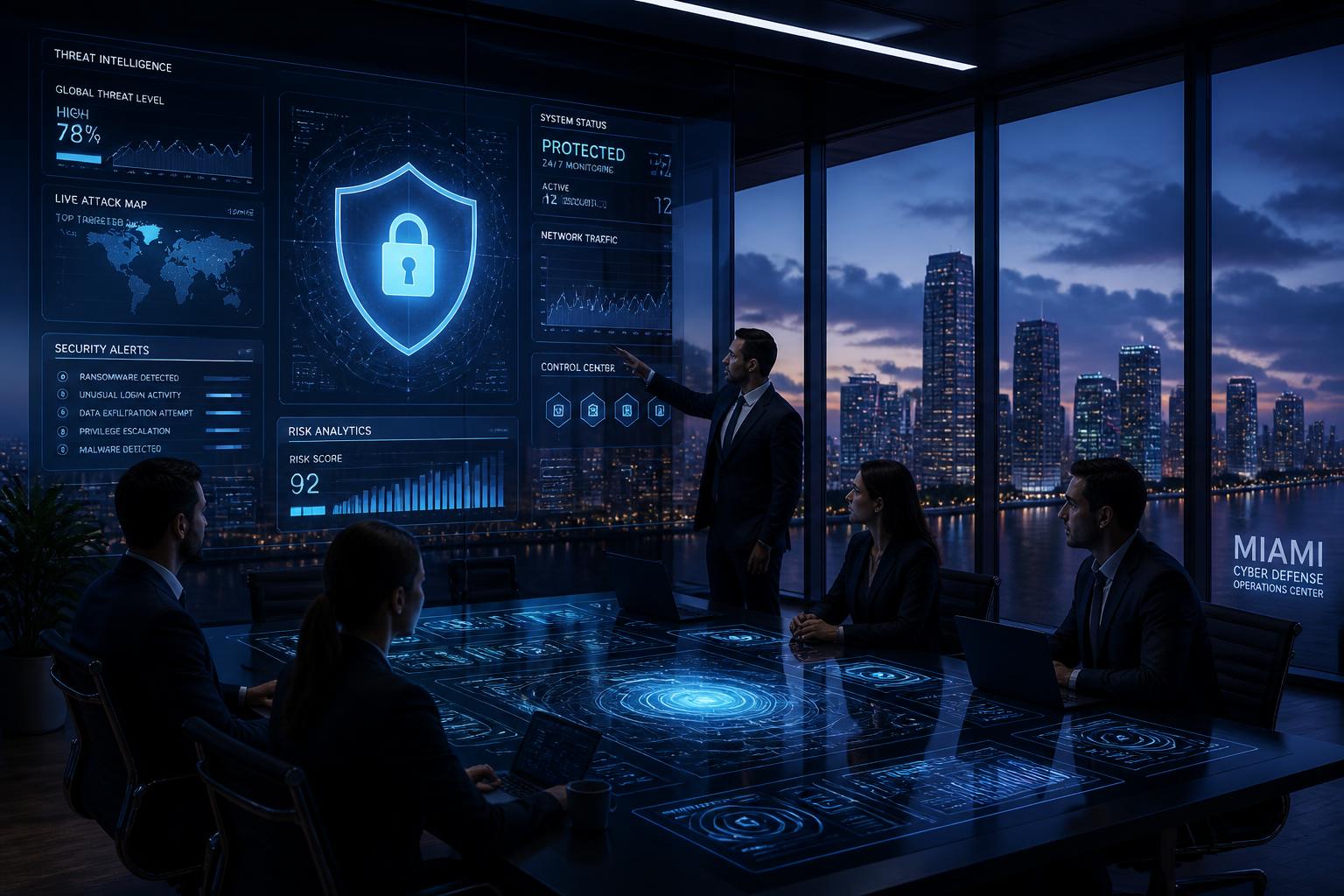
Every week we talk to a business owner who was sold 'a cybersecurity solution' — usually a single antivirus subscription, a firewall appliance, or a managed IT contract with 'security included' — and genuinely believed they were covered. Then a wire got redirected, a laptop got encrypted, or a customer database showed up on a dark web forum. The uncomfortable truth in 2026 is that there is no single cybersecurity solution for business. There is a stack. This guide is the vendor-neutral map of that stack — what each layer does, why it matters, what to buy, what to skip, and the order to buy it in.
We'll frame everything against the NIST Cybersecurity Framework 2.0, because that's the standard your auditors, insurers, and enterprise customers already speak. If you'd rather have Cybrvault design and run this stack for you, skip to Cybrvault business cybersecurity services or book a free consult.
What 'cybersecurity solutions for business' actually means in 2026
A modern business cybersecurity program is the integrated set of controls, tools, processes, and people that keep confidential data confidential, systems available, and transactions authentic — across identity, endpoints, email, network, cloud, data, and physical operations. It is measured against a framework (NIST CSF 2.0, ISO 27001, CIS Controls v8, or CMMC 2.0 for defense contractors) — not against a marketing brochure.
The threat model has shifted decisively. In 2026, more than 80% of breaches begin with a stolen credential (usually harvested by an infostealer on an employee's personal or work device), not a zero-day exploit. Initial access brokers sell corporate logins to ransomware crews within days. AI-generated phishing, voice-cloned CEO fraud, and business email compromise now account for the largest chunk of insured cyber losses. Your solutions stack has to be built for that reality, not the 2015 antivirus era.
The NIST CSF 2.0 lens: how to map any solution to a business outcome
NIST Cybersecurity Framework 2.0 organizes every possible cybersecurity control into six functions. Any solution you evaluate should map cleanly to one or more of these — if a vendor cannot explain which function their tool serves, that is a red flag.
- Govern — policies, risk management, roles, third-party risk, board reporting. Solutions: GRC platforms (Vanta, Drata, Secureframe), vCISO services, policy libraries.
- Identify — asset inventory, vulnerability discovery, data classification, business impact analysis. Solutions: Nessus, Qualys, Rapid7, asset discovery in EDR, attack surface management.
- Protect — identity, MFA, access control, patching, encryption, backups, awareness training. Solutions: Microsoft Entra ID, Okta, 1Password, YubiKeys, KnowBe4, Automox.
- Detect — endpoint detection, log monitoring, network monitoring, threat intel, dark web monitoring. Solutions: CrowdStrike, SentinelOne, Microsoft Defender for Endpoint, Huntress, Arctic Wolf, Blumira.
- Respond — incident response, forensics, communications, containment. Solutions: MDR services, incident response retainers, tabletop exercises, IR playbooks.
- Recover — backups, restore testing, business continuity, cyber insurance. Solutions: Datto, Veeam, Rubrik, immutable/air-gapped cloud backup, DR-as-a-Service.
A mature program has at least one active control in every function. A dangerous program has three tools in Protect and nothing in Detect, Respond, or Recover — which is the 2015 antivirus-only posture that still dominates small business today.
The 8-layer business cybersecurity stack (in buying order)
This is the order we deploy for a typical 10–250 employee Miami business — each layer building on the previous. Skipping a layer to jump ahead almost always fails, because the skipped layer is exactly where the attacker walks in.
Layer 1 — Identity and access (buy this first, always)
Identity is the new perimeter. Enforce phishing-resistant MFA (passkeys, FIDO2 hardware keys, or number-matching authenticator apps — not SMS) on every account: email, VPN, cloud console, admin panels, payroll, and banking. Deploy SSO through Microsoft Entra ID, Okta, or Google Workspace so you can revoke access in one place. Deploy a business password manager (1Password Business, Bitwarden Teams, Keeper) so employees stop reusing 'Summer2024!' across 40 systems.
Add conditional access policies: block logins from countries you don't operate in, block legacy authentication protocols, require compliant devices for admin roles. Cost: roughly $10–$25 per user per month all-in. Impact: eliminates the single largest breach vector.
Layer 2 — Endpoint detection and response (EDR)
Traditional antivirus is dead. In 2026 you need EDR or MDR — CrowdStrike Falcon, SentinelOne, Microsoft Defender for Endpoint Plan 2, Huntress, or Sophos Intercept X — on every laptop, desktop, and server. EDR watches behavior (process trees, memory injection, LOLBins) instead of just file signatures, catches fileless attacks, and gives you an audit trail for incident response. Free/consumer antivirus catches 30–60% of modern threats; EDR catches 95%+ and, more importantly, tells you what happened after the fact.
Cost: $8–$20 per endpoint per month. If you don't have a security team to triage alerts, pay for the managed version (MDR) — a 24/7 SOC watches your alerts and responds so you don't wake up to encrypted servers on Sunday morning.
Layer 3 — Email security, DMARC, and phishing defense
Email is still the #1 initial access vector — phishing, business email compromise, malicious attachments, and vendor invoice fraud. Microsoft 365 E3/E5 (Defender for Office 365) and Google Workspace Enterprise include strong baseline filtering; layer on Abnormal Security, Avanan, IRONSCALES, or Proofpoint for BEC and social-engineering detection.
Publish SPF, DKIM, and DMARC records at p=reject for every domain you own (including parked and legacy domains). Run a phishing simulation and training program — KnowBe4, Hoxhunt, or Curricula — monthly, not annually. Set an out-of-band callback rule for every wire transfer, banking change, or vendor payment change, and put it in writing.
Layer 4 — Patch and vulnerability management
Unpatched CVEs are how ransomware crews get in when phishing fails. Deploy an RMM (NinjaOne, Automox, ConnectWise Automate, Kaseya) or use Microsoft Intune to force OS, browser, and third-party app updates within 14 days of release for critical CVEs. Run authenticated vulnerability scans monthly with Nessus, Qualys, Rapid7, or Tenable.io. Publish an internal SLA: critical vulns patched in 7 days, high in 30.
Layer 5 — Backup and recovery (immutable + tested)
The ransomware playbook in 2026 is: exfiltrate data, delete backups, then encrypt. If your backups are not immutable and off-site, you don't have backups — you have a false sense of security. Deploy 3-2-1-1-0 backups: 3 copies, 2 media, 1 off-site, 1 immutable/air-gapped, 0 errors on last restore test. Datto, Veeam with immutable object lock on S3/Wasabi, Rubrik, or Cove Data Protection all work. Test a full restore quarterly — untested backups fail 40% of the time.
Layer 6 — 24/7 monitoring and detection (SOC / MDR / MSSP)
Alerts you don't watch don't protect you. If you don't have a 24/7 internal SOC (almost no SMB does), buy Managed Detection and Response — Arctic Wolf, Huntress, Blumira, Expel, Red Canary, eSentire, or a regional MSSP like Cybrvault. They ingest logs from EDR, firewall, cloud, and identity, correlate them, and respond within minutes. A ransomware attack detected at hour 1 is a Monday morning inconvenience; detected at hour 48 it's a business-ending event.
Cost: $50–$200 per user per month depending on data volume and scope. For most 20–200 employee businesses this replaces two full-time SOC hires and delivers better coverage.
Layer 7 — Network, cloud, and data protection
Deploy a next-gen firewall (Fortinet, Palo Alto, SonicWall, or Meraki MX) with IPS enabled and outbound DNS filtering (Cisco Umbrella, DNSFilter, NextDNS). Segment guest Wi-Fi, IoT, and production networks. For cloud, turn on the native security posture tools — Microsoft Defender for Cloud, AWS Security Hub + GuardDuty, Google Security Command Center — and remediate the misconfigurations they surface. For sensitive data, deploy DLP (Microsoft Purview, Nightfall, Cyberhaven) to block accidental exfiltration to personal email, ChatGPT, or unmanaged devices.
Layer 8 — Governance, risk, compliance (vCISO)
This is what turns a pile of tools into a program. A virtual CISO (vCISO) — fractional senior security leadership — owns the risk register, quarterly board reporting, cyber insurance renewals, vendor risk reviews, SOC 2 / ISO 27001 / HIPAA / CMMC readiness, and incident tabletops. Expect $2,500–$10,000 per month for a fractional vCISO; a full-time CISO in Miami runs $220k+ base.
How much should business cybersecurity cost in 2026?
Real-world benchmarks we see for South Florida businesses:
- Micro business (1–10 employees): $75–$150 per user per month all-in. Identity, EDR/MDR, email security, backup, security awareness. Roughly $9k–$18k per year.
- Small business (10–50 employees): $100–$200 per user per month. Add 24/7 SOC monitoring, vulnerability management, vCISO oversight. Roughly $12k–$120k per year.
- Mid-market (50–250 employees): $150–$250 per user per month. Add DLP, CASB, cloud security posture management, red team testing, compliance program (SOC 2 / ISO 27001 / HIPAA / CMMC).
- Cyber insurance: separate line item. Premiums 2026 average $1,500–$10,000 per $1M of coverage — carriers now require MFA, EDR, immutable backups, and email security as a precondition of coverage. Skipping the stack means uninsurable, not just insecure.
If a proposal comes in dramatically under these ranges, ask which of the 8 layers is missing. It's almost always Detect, Respond, and Recover — the layers that make the difference between a small incident and a front-page breach.
Build in-house vs. buy managed services
For any business under ~500 employees in 2026, buying managed services beats building in-house on almost every dimension: coverage (24/7 vs. business hours), cost (one MSSP contract vs. 3–6 senior hires), speed (deployed in weeks vs. hiring in months), and specialization (a full IR team vs. one generalist). The exception is regulated industries where you need dedicated staff for compliance — even then, the modern pattern is 1–2 internal security leaders plus a managed SOC underneath.
The 12 questions to ask any cybersecurity vendor before you sign
- 1Which NIST CSF 2.0 functions does your solution cover — Govern, Identify, Protect, Detect, Respond, or Recover?
- 2Do you provide 24/7/365 human analyst response, or are alerts emailed to us to triage?
- 3What is your mean time to detect (MTTD) and mean time to respond (MTTR), measured against last quarter's real incidents?
- 4Do you deploy phishing-resistant MFA (passkeys / FIDO2) by default, and how do you handle exception requests?
- 5Are our backups immutable and air-gapped, and when was the last full restore test?
- 6What is included in incident response — do you have a retainer, or is IR billed separately at $500+/hour during an active breach?
- 7Are you SOC 2 Type II certified, and can you share the current report under NDA?
- 8How do you evidence controls for our cyber insurance renewal and for SOC 2 / HIPAA / CMMC audits?
- 9What is your data breach notification SLA to us — hours or days?
- 10Who owns the logs and telemetry when we terminate the contract, and how do we get them back?
- 11What is the true monthly cost per user, all-in, with no hidden data or endpoint overage charges?
- 12Can you provide three references from businesses of our size and industry we can call?
Common cybersecurity buying mistakes (we see these weekly)
- Buying antivirus and calling it 'endpoint security' — modern threats need EDR/MDR, not signature-based AV.
- Assuming Microsoft 365 Business Basic includes real security — it doesn't. You need at minimum Business Premium + Defender for Business, or E3/E5.
- Relying on SMS MFA — SIM swap attacks in South Florida are trivial. Use authenticator apps or hardware keys.
- Backing up to a NAS on the same network — ransomware encrypts it. Backups must be immutable and off-site.
- Trusting an MSP that markets 'security included' without a named SOC, MDR platform, or vCISO. IT support is not security.
- Buying cyber insurance without implementing the controls the policy requires — claims get denied for material misrepresentation.
- Running a phishing test once, seeing 30% click rate, and doing nothing about it. Training is a program, not an event.
- No incident response plan on paper. When ransomware hits at 2am you will not invent a plan from scratch.
Regulatory drivers — what will force you to upgrade
Even if you don't feel the risk, regulators and customers will. In 2026, the biggest pressure sources for South Florida businesses:
- Florida Information Protection Act (FIPA) — 30-day breach notification to affected consumers and, for large breaches, the Florida Department of Legal Affairs.
- FTC Safeguards Rule — applies to any business meeting the 'financial institution' definition, including many auto dealers, mortgage brokers, and CPAs. Requires written information security program, MFA, encryption, and a qualified individual.
- HIPAA / HITECH — for medical, dental, behavioral health, and their business associates. Enforcement fines are up sharply in 2025–2026.
- PCI DSS 4.0 — enforced March 2025 for all merchants; adds phishing-resistant MFA and script integrity monitoring.
- CMMC 2.0 — required for any DoD contractor handling FCI or CUI, phasing in through 2026.
- SEC cybersecurity disclosure rules — public companies must disclose material incidents within 4 business days.
- Cyber insurance underwriting questions — carriers now enforce a de facto minimum control set (MFA, EDR, immutable backups, email security, IR plan).
A 90-day rollout plan for a business starting from zero
- 1Days 1–14: inventory every user, device, SaaS app, and admin account. Turn on MFA (authenticator app minimum) everywhere. Change all shared/service passwords. Remove ex-employees.
- 2Days 15–30: deploy business password manager and SSO. Roll out EDR/MDR to all endpoints. Enable Microsoft/Google baseline security defaults.
- 3Days 31–45: implement email security add-on, publish SPF/DKIM/DMARC at reject, run first phishing simulation, deploy security awareness training.
- 4Days 46–60: stand up immutable backups with tested restore. Deploy DNS filtering and next-gen firewall rules. Enable cloud security posture monitoring.
- 5Days 61–75: onboard MDR / 24/7 SOC monitoring. Run first vulnerability scan and patch critical findings. Write and socialize incident response plan.
- 6Days 76–90: engage vCISO. Complete cyber insurance application with real controls in place. Run first tabletop exercise. Set quarterly program review cadence.
Cybrvault business cybersecurity services
Cybrvault designs, deploys, and runs the full 8-layer business cybersecurity stack for Miami, Fort Lauderdale, Boca Raton, and Palm Beach companies. One team, one contract, one accountable throat to choke — identity, endpoint, email, network, backups, 24/7 SOC monitoring, incident response, and vCISO-led governance.
- Miami cybersecurity services — full-stack managed security tailored to South Florida businesses.
- 24/7 SOC monitoring — human-analyst detection and response, not just automated alerts.
- Ethical hacking and penetration testing — prove your defenses work before an attacker does.
- OSINT investigations — executive protection, brand monitoring, fraud investigations.
- Miami cybersecurity consulting — vCISO, compliance, and program design.
- Small business cybersecurity guide — companion read for owners still building the stack.
Ready to see what a real business cybersecurity program looks like for your company? Book a free 30-minute consult — we'll map your current stack against NIST CSF 2.0, identify the highest-risk gaps, and give you a prioritized 90-day plan. No sales pressure, no fear-mongering, just engineering.
Get the 10-step Cyber Hardening Checklist
The exact steps our Miami team uses to lock down people and small businesses — takes under an hour. Instant access, no call required.
// frequently asked
Questions teams ask us
What is the best cybersecurity solution for a small business in 2026?+
There is no single 'best' solution — a real small business cybersecurity program is a stack of 6–8 controls working together: phishing-resistant MFA, EDR (endpoint detection and response), email security with DMARC enforcement, immutable backups, 24/7 monitoring (MDR), patch management, and a written incident response plan. For most 10–50 person Miami businesses, the fastest path is a managed program from an MSSP that bundles all of the above for $100–$200 per user per month.
How much should a business spend on cybersecurity?+
Benchmark 3–8% of total IT budget, or roughly $75–$250 per employee per month all-in, depending on company size and regulatory posture. Micro businesses (1–10 employees) can run a solid program for $9k–$18k per year. Mid-market companies (50–250 employees) typically spend $150–$300k per year for a full managed program with vCISO, MDR, and compliance support. Under-spending is almost always false economy — a single ransomware event averages $250k+ in direct costs plus downtime, legal, and reputation damage.
What is the difference between MSP, MSSP, and MDR?+
An MSP (Managed Service Provider) handles general IT — help desk, patching, hardware, cloud administration. An MSSP (Managed Security Service Provider) specializes in security operations — SIEM, log monitoring, threat intel, vulnerability management, and compliance. MDR (Managed Detection and Response) is a focused subset of MSSP that combines EDR technology plus a 24/7 human SOC that actively responds to threats on your behalf. Many MSPs claim to do security but lack a real SOC or SIEM — always verify by asking who monitors alerts at 3am and what their mean time to respond is.
Is Microsoft 365 or Google Workspace secure enough by itself?+
The higher-tier plans (Microsoft 365 Business Premium, E3, E5 or Google Workspace Enterprise) include strong baseline security — MFA, Defender for Office/Endpoint, conditional access, DLP, and audit logs — that most small businesses never configure or monitor. The technology is there; the operational maturity usually is not. For real protection you need those licenses properly configured, integrated with an EDR, and monitored by a 24/7 SOC. Business Basic and Business Standard plans are not sufficient for a modern threat model.
What is the NIST Cybersecurity Framework 2.0 and do I need it?+
NIST CSF 2.0 is the U.S. government's vendor-neutral framework for organizing a cybersecurity program into six functions: Govern, Identify, Protect, Detect, Respond, and Recover. You are not legally required to adopt it (unless you contract with the federal government), but nearly every cyber insurance carrier, enterprise customer, and auditor now uses it as the de facto benchmark. Mapping your current tools to CSF 2.0 is the fastest way to see which functions you have covered and which are wide open.
Do I need a virtual CISO (vCISO)?+
If you have more than about 25 employees, handle regulated data (PHI, PCI, CUI, financial), sell to enterprise customers who send security questionnaires, or carry cyber insurance, yes — you need CISO-level oversight. A full-time CISO in Miami costs $220k+ base plus equity. A fractional vCISO delivers the same strategic role — risk register, board reporting, compliance program, vendor risk, insurance renewals, tabletops — for $2,500–$10,000 per month. Cybrvault offers vCISO services as part of our managed programs.
How fast can a business deploy a real cybersecurity program?+
A focused 90-day rollout is realistic for a business starting from near-zero: weeks 1–4 for identity and endpoint, weeks 5–8 for email, backup, and network, weeks 9–12 for 24/7 monitoring, incident response, and governance. Compliance certifications (SOC 2 Type II, ISO 27001, CMMC Level 2) take 6–12 months on top of the underlying controls. The mistake is trying to buy compliance without first deploying the controls — the audit will fail.
// miami, fl services
Cybersecurity built for South Florida
// need help applying this?
Book a free, confidential consultation.
Our engineers can map this to your environment in 30 minutes.
Get secured// keep reading
Related articles

Business Security
Business Network Security in 2026: How to Keep Your Miami Business Safe From Hackers
A practical, step-by-step business network security guide for Miami and South Florida companies: how attackers actually get in, the layered controls that stop them, what to budget, and a 30-day hardening plan you can start today.

Business Security
Cyber Insurance for Small Business (2026): The Miami Owner's Guide to Coverage, Costs & Claims
Cyber insurance is now the difference between a bad week and a closed business for Miami small companies. Here is what policies actually cover in 2026, what underwriters demand before they will quote you, what a claim really looks like after a ransomware hit, and how much coverage a South Florida business should carry.

Business Security
How to Prevent Phishing Attacks (2026): The South Florida Business & Family Guide
Phishing is the entry point for the overwhelming majority of breaches we investigate across Miami, Fort Lauderdale and West Palm Beach. Here is how modern phishing actually works in 2026, the 21 controls that stop it, and the exact 60-minute response plan to run when someone clicks.
Under attack right now? Our 24/7 line responds immediately.