
Regional
The Miami Cybersecurity Landscape: Why South Florida Is a Target
International banking, crypto, maritime trade and high-net-worth residents make Miami one of the most heavily targeted metros in the United States. Here's what we see from the ground — and what local businesses should actually do about it.
Cybercrime follows money, and money flows through Miami. The metro is home to more international bank branches than any US city outside New York, a deep crypto and fintech bench, the largest cruise port in the world, one of the densest concentrations of family offices in the Western Hemisphere, and a real-estate market where eight-figure all-cash closings are routine. Every one of those concentrations is a target.
What we see in client telemetry
Wire fraud on real-estate closings
South Florida title companies and real-estate attorneys are repeat targets for business email compromise tuned to the closing workflow. The typical pattern: attacker compromises the email of one party to the transaction (often weeks before closing), monitors for the wire instructions, then sends spoofed instructions from a lookalike domain right before funds are due. Local FBI field-office advisories have flagged this as a sustained campaign every year since 2019.
Yacht and aircraft purchase wires
Same playbook, larger amounts. Yacht brokers, aircraft brokers, and the law firms supporting them see the same wire-fraud pattern with seven- and eight-figure stakes. Most local marina and FBO infrastructure is owned by small operators with limited security maturity — which is exactly why they're targeted.
Spanish-language lures aimed at LATAM-facing companies
Miami's role as the commercial hub for Latin America makes Spanish-language phishing materially more dangerous here than in most US metros. Lures impersonate regional banks, customs brokers, and shipping agents. Generic English-language phishing training doesn't prepare staff for it; localized training does.
Family-office social engineering
Family offices and high-net-worth households are a particularly difficult attack surface: the operational team is small, the spend authority is large, and the principal often resists security friction. We see attackers patiently building relationships with house managers, personal assistants and CFOs — sometimes over months — before triggering a wire request, vendor change, or 'urgent' instruction.
Crypto and fintech targeting
Miami's crypto scene draws the full spectrum of crypto-native attacks: SIM swaps targeting executive phone numbers, smart-contract phishing, fake-recruiter approaches on LinkedIn aimed at engineers with key access, and supply-chain attacks against the dev tooling these companies use.
What's working locally
- Hardware-key MFA on every account that can authorize, approve, or move money. Passkeys are catching up, but FIDO2 hardware keys remain the gold standard for principals and signatories.
- Callback verification on any wire over a fixed threshold ($50K is a common starting point), to a known phone number — not the number in the email.
- Threat-intelligence feeds tuned to Caribbean and LATAM infrastructure, not just generic US IOC streams.
- Localized phishing-simulation campaigns in Spanish and Portuguese, not just English.
- Quarterly tabletop exercises with executives and principals — not just IT. The wire that goes out is the wire the principal approved.
What isn't working
- 'We're too small to be a target.' The smallest local breach we've responded to was an 11-person professional-services firm; the loss was $487K and the firm did not survive the year.
- Outsourcing to a generic MSSP three time zones away. Response time and local context both matter when the wire is leaving today.
- Treating Miami's location as a marketing asset without addressing the threat picture that comes with it. International exposure cuts both ways.
- Relying on the bank's fraud detection to catch wire fraud. Bank fraud teams catch some of it. They are not the last line of defense — your controls are.
What we recommend for South Florida businesses
- 1Treat wire workflows as a security-critical process. Document them, dual-control them, callback-verify them, exercise them quarterly.
- 2Deploy phishing-resistant MFA universally, not just on admin accounts. Spanish-language BEC targets sales staff just as often as it targets finance.
- 3Run quarterly Spanish + English phishing exercises if you have any LATAM-facing operations.
- 4Engage local incident response. Same-time-zone, on-site-when-needed response materially reduces dwell time and reputational damage.
- 5Maintain a cyber-insurance policy with a known IR firm and pre-approved hourly rates. South Florida claim activity has driven premiums up — make sure you're getting the coverage you're paying for.
Where Cybrvault fits
Cybrvault is headquartered in Miami with engineers on the ground from the Keys to Palm Beach, and remote response capability across the United States. We run security programs for local businesses, family offices, and crypto/fintech firms — and we respond to incidents on a 24/7 basis. If you operate in or out of South Florida and you're not sure whether your wire workflow or your principal's accounts are properly protected, that's the conversation to have first.
Get the 10-step Cyber Hardening Checklist
The exact steps our Miami team uses to lock down people and small businesses — takes under an hour. Instant access, no call required.
// frequently asked
Questions teams ask us
Is Miami really more targeted than other US cities?+
By per-capita business email compromise loss reports and by concentration of high-value targets (international banking, crypto, family offices, maritime), yes — Miami consistently appears in the top 5 US metros in FBI IC3 reporting.
What's the most common cyber attack on South Florida businesses?+
Business email compromise targeting wire-transfer workflows is the most frequent and most financially damaging category in our local client telemetry, followed by ransomware against small professional-services firms.
Do family offices really need cybersecurity programs?+
Yes — and most don't have one. Family offices combine high spend authority, small teams, weak segregation of duties, and reluctant-to-train principals. The threat actors know all of that.
How much should a small Miami business spend on cybersecurity?+
A reasonable target is 3–6% of IT spend, or roughly $50–$150 per user per month all-in (tools + outside services + insurance) for a 25–100-person professional-services firm in 2026.
// miami, fl services
Cybersecurity built for South Florida
// need help applying this?
Book a free, confidential consultation.
Our engineers can map this to your environment in 30 minutes.
Get secured// keep reading
Related articles
Business Cybersecurity
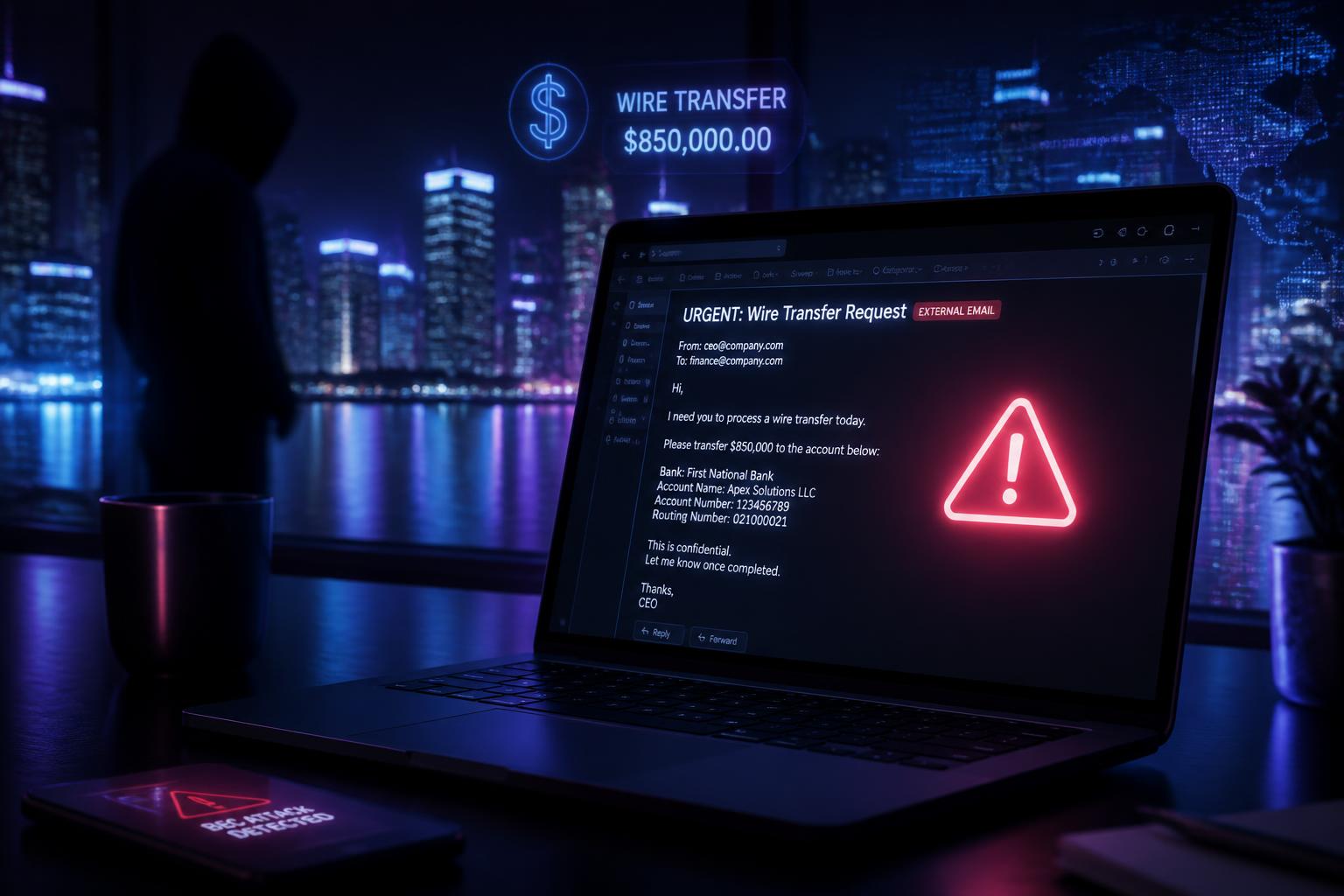
Business Email Compromise (BEC) in 2026: The Miami Business Owner's Prevention Playbook
Miami-Fort Lauderdale is a top-three U.S. metro for BEC losses. This 2026 field guide from Cybrvault breaks down exactly how business email compromise works today (AI voice clones, vendor takeovers, title-company wire fraud), the 12 controls that actually stop it, and the first 72 hours if you're already hit.
Personal Cybersecurity
Personal Cybersecurity for Miami Business Owners (2026): The Playbook Attackers Don't Want You to Have
In Miami, attackers stop targeting your company and start targeting you — the owner. This 2026 field guide from Cybrvault walks South Florida founders, executives, and family offices through the exact personal cybersecurity stack (devices, accounts, MFA, home network, family, travel, and wire-fraud defense) that stops the attacks we actually respond to every week.
Threats & Scams
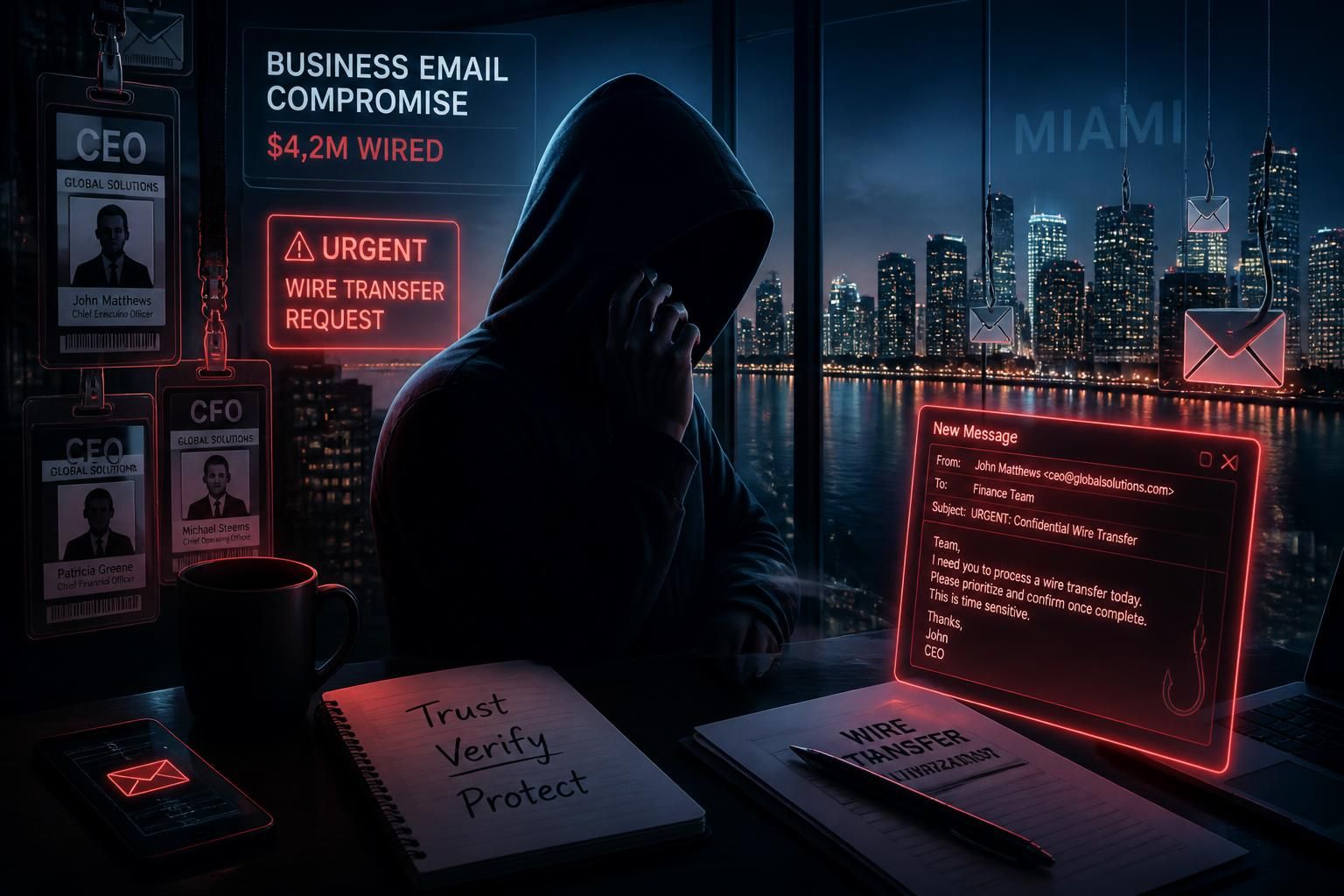
Social Engineering Attack Examples: 12 Real Scams Hitting Miami Businesses in 2026
Social engineering is behind more than 74% of breaches. This 2026 guide walks through 12 real social engineering attack examples — from CEO wire-fraud emails and vishing calls hitting Brickell finance teams to QR-code phishing in Wynwood coworking spaces — with the exact red flags, sample scripts, and Miami-specific defenses your team needs.
Under attack right now? Our 24/7 line responds immediately.