Email security
Why Your Phishing Filter Stopped Working in 2026 (and What Replaces It)
Generative AI didn't just make phishing easier — it broke the signal-based defenses you've relied on for a decade. Here's the new model, the tools that implement it, and what to retire.

Traditional secure email gateways were built on signals: known-bad senders, suspicious URL reputation, telltale grammar mistakes, attachment hashes matching known malware. Every one of those signals is now adversary-controlled. LLMs write fluent, personalized lures in any language at zero cost. Residential proxy networks rotate sender infrastructure faster than reputation systems can update. Lookalike domains are registered, used and burned within a single business day. Detonation chambers are evaded by malware that checks for sandbox artifacts before unpacking.
Our SOC's 2025 telemetry across mid-market US clients showed a 4.3x year-over-year increase in business email compromise attempts that bypassed the incumbent secure email gateway entirely. The attackers didn't get better at evasion — the gateway's model of 'bad' just stopped describing reality.
The new model: behavioral, not signal-based
The shift is from 'does this email look bad?' to 'does this email fit the relationship?' A behavioral system builds a baseline for every sender-recipient pair in your organization: typical tone, typical request patterns, typical timing, typical attachment types, typical reply latency. When a message deviates from that baseline in a way that correlates with known fraud patterns, it gets flagged or quarantined.
A wire-transfer request from a CFO who has never asked for one before is suspicious even if every header checks out. A vendor invoice with new banking details from a contact you've worked with for three years is suspicious even if the domain is correct. A 'quick favor' from the CEO sent at 11:47 PM on a Sunday is suspicious even if it's grammatically perfect. Signal-based tools miss all three. Behavioral tools catch them.
What to deploy now
Layer 1: Behavioral email security
Add a behavioral layer on top of your existing gateway — don't replace. The incumbent (Microsoft Defender for Office 365, Proofpoint, Mimecast) still handles bulk spam, commodity malware and known-bad infrastructure well. The behavioral layer catches what the incumbent misses.
- Abnormal Security — the established leader for behavioral BEC detection in Microsoft 365 environments.
- Sublime Security — open detection language, strong for teams that want to tune rules in-house.
- Material Security — broader scope including data-at-rest protection in mailboxes; good for healthcare and finance.
Layer 2: Phishing-resistant MFA
Even the best email filter has a non-zero miss rate. Phishing-resistant MFA closes the attack path after a click. Passkeys (WebAuthn) and FIDO2 hardware keys cannot be phished because the authenticator binds the response to the actual origin — an attacker proxying credentials through Evilginx or a similar AiTM kit gets a credential that won't work anywhere else.
Push notifications and SMS codes are not phishing-resistant. Push fatigue attacks bypassed Cisco, Uber and others in 2022; SMS interception via SIM swap is a $400 service on the open market. If your organization still uses either, prioritize migration.
Layer 3: Fast, low-friction reporting
Your users see threats your tools miss. Give them a one-click report button in their email client that ships the message to your SOC with full headers. Measure and reward reporting. Most organizations under-invest here because it doesn't have a vendor pitching it.
What to retire
- SMS-based one-time codes for any privileged account.
- Security-awareness training that's an annual video. Replace with short, frequent, scenario-based exercises tied to your actual incident data.
- Any process where 'urgent' beats 'verified.' If your wire-approval workflow can be rushed, it will be — by the next attacker.
- Header-based 'this is from outside your organization' banners as your only external-mail control. Users banner-blind within weeks.
How to know if it's working
Track three numbers, monthly, on the same dashboard:
- 1BEC catch rate by the behavioral layer (messages quarantined after passing the incumbent gateway).
- 2User report-to-quarantine time (median minutes from report to global removal across all mailboxes).
- 3Phishing-resistant MFA coverage percentage of privileged accounts, trending toward 100%.
Where Cybrvault fits
We deploy and tune this stack for clients across South Florida and the wider US — typical engagement is 4–6 weeks from kickoff to production, including a 30-day baseline period for the behavioral layer. If your incumbent is missing things you can see in user reports, that's the signal it's time to add a layer.
Get the 10-step Cyber Hardening Checklist
The exact steps our Miami team uses to lock down people and small businesses — takes under an hour. Instant access, no call required.
// frequently asked
Questions teams ask us
Do I need to replace my existing secure email gateway?+
No. Behavioral security tools are designed to layer on top of Microsoft 365 / Defender, Proofpoint, or Mimecast. The incumbent handles bulk volume; the behavioral layer handles targeted attacks. Replacement is rarely the right move.
Are passkeys really phishing-resistant?+
Yes, when properly deployed. The WebAuthn standard binds the authentication response to the actual origin (domain) of the relying party. An attacker proxying your login through a fake site cannot obtain a credential that works against the real site.
How much does AI-augmented email security cost?+
Typical list pricing for behavioral platforms in 2026 is $30–$60 per mailbox per year on top of your existing gateway. For mid-market organizations, a Microsoft E5 + Abnormal stack runs roughly $80–$120 per user per year fully loaded.
Can users tell the difference between a legitimate AI-written email and a phishing attempt?+
Increasingly, no. That's exactly why the defense has to shift to behavioral and to phishing-resistant MFA — relying on users to spot the lure no longer scales.
// miami, fl services
Cybersecurity built for South Florida
// need help applying this?
Book a free, confidential consultation.
Our engineers can map this to your environment in 30 minutes.
Get secured// keep reading
Related articles
Identity & Access
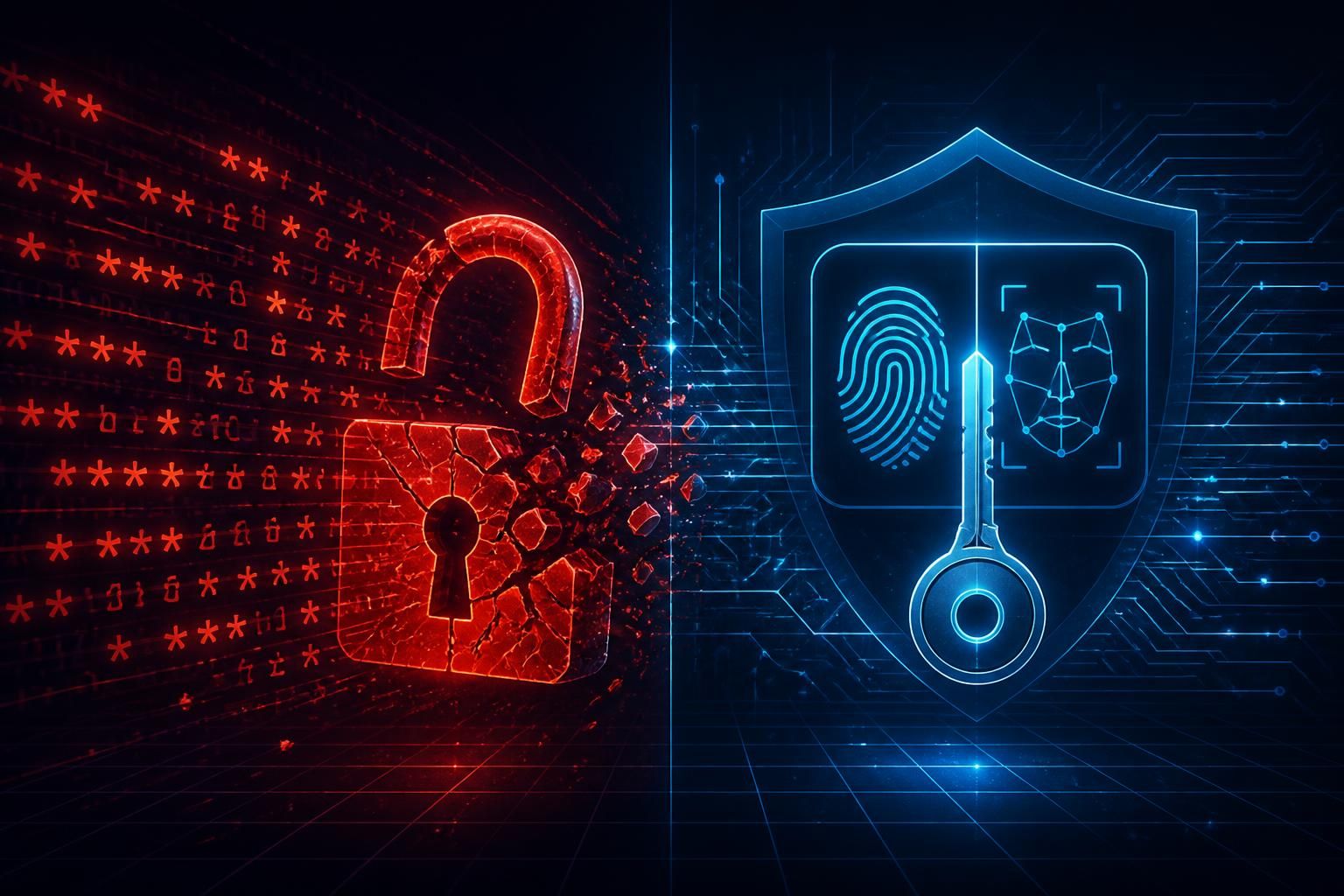
Passkeys vs Passwords: The Complete 2026 Guide (And Why Your Business Should Switch Now)
Passkeys replace passwords with phishing-resistant cryptographic keys tied to your device's biometrics. Here's exactly how they work, where they win, where they still hurt, and the 7-step rollout plan our Cybrvault team uses for small businesses in 2026.
Architecture
Zero Trust for the 50-Person Company (Without a $1M Budget)
Zero trust isn't a product and it isn't only for the Fortune 500. Here's a pragmatic 90-day path a small team can actually finish — sequenced by impact, not vendor pitch.

Personal Security
Best Cybersecurity Practices for Individuals: 2026 Guide
Follow a practical, prioritized personal cybersecurity checklist for safer accounts, devices, home Wi-Fi, finances, travel, family communications, and recovery.
Under attack right now? Our 24/7 line responds immediately.