AI & Cybersecurity
AI Voice Scams in 2026: How to Spot Deepfake Phone Calls Before They Drain Your Bank Account
AI voice cloning now takes 3 seconds of audio and $0 of software. In 2026, deepfake phone scams are the fastest-growing attack on US families and businesses — here is exactly how they work, the 7 red flags to listen for, and the one-word 'safe phrase' that stops them cold.
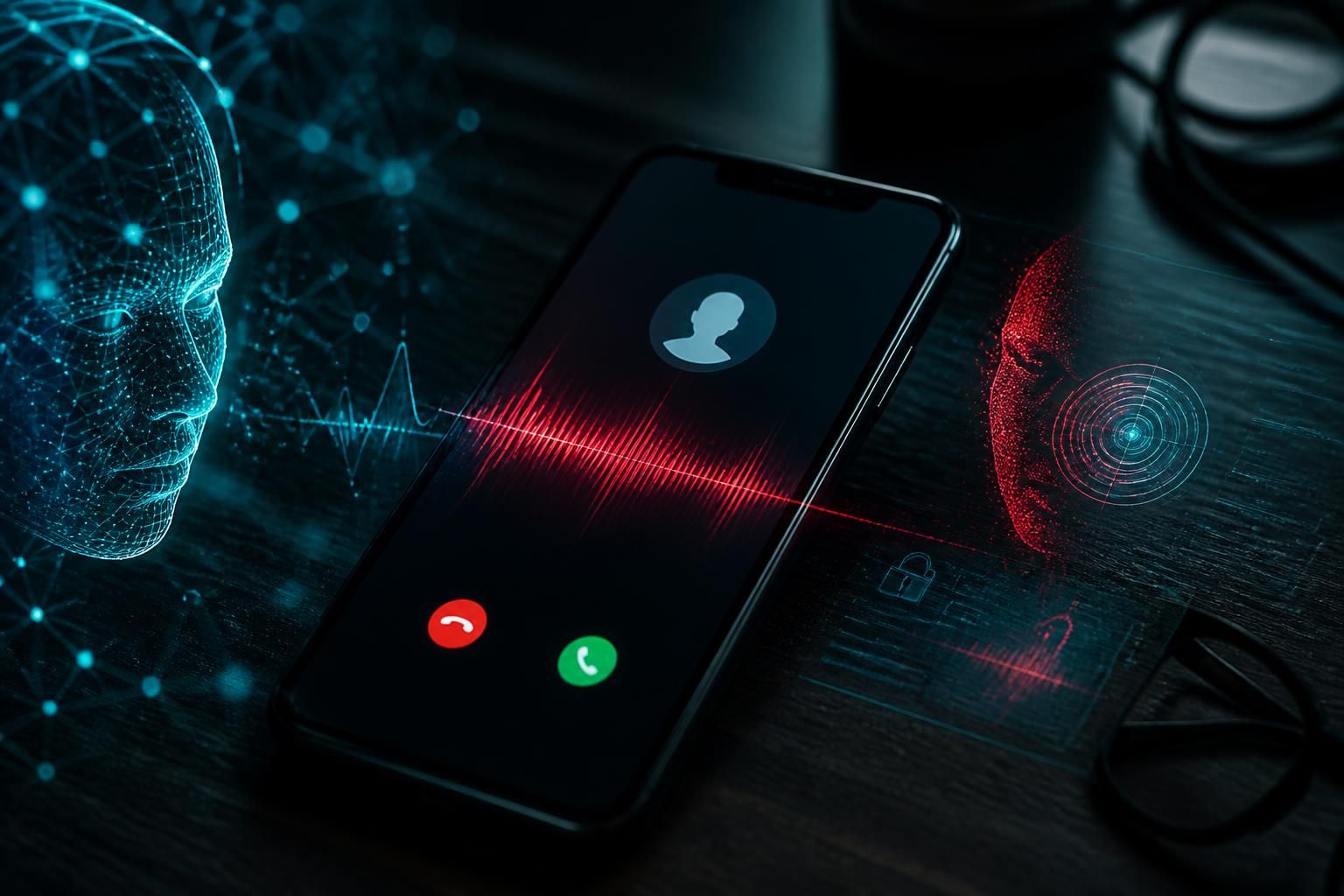
In January 2024, a finance worker at the Hong Kong office of engineering firm Arup wired $25.6 million to scammers after a video conference with the company's 'CFO' and several 'colleagues.' Every face and voice on the call was AI-generated. By 2026, the same attack costs the criminal under $50 in compute and runs in real time on a consumer GPU.
AI voice scams are now the fastest-growing fraud category in the United States. The FBI's 2025 Internet Crime Report flagged voice-cloning fraud as a 'top emerging threat,' and the FTC logged a 1,200% increase in deepfake-related complaints between 2023 and 2025. At Cybrvault, we handle a deepfake-related incident from a Miami client almost every week — half of them are families, half are small businesses.
This guide is the exact playbook we walk clients through. It works whether you are a parent who just got a 3 AM 'kidnapping' call or a controller who almost wired six figures to a fake CEO.
How AI Voice Cloning Actually Works in 2026
You do not need to understand machine learning to defend against this, but understanding the speed and cost is what convinces most people to take it seriously.
- Sample size needed: 3 seconds in 2026, down from 60 seconds in 2023. One TikTok comment reply, one voicemail greeting, or one Instagram Story is enough.
- Tools used: open-source models like XTTS-v2, F5-TTS, and the leaked ElevenLabs v3 weights. All free. All run on a $400 used RTX 3060.
- Latency: under 200 milliseconds. The voice can respond in real time to whatever you say on the call.
- Languages: 30+ supported, including code-switching between English and Spanish mid-sentence — extremely common in scams targeting South Florida families.
- Cost to the scammer: about $0.01 per minute of cloned speech, including spoofed caller ID and a voice-over-IP origination.
Translation: the economics now favor running this scam against ordinary middle-class households, not just CEOs. A single scammer in a call center can clone 200 voices a day from public social media and run them through an autodialer.
The 5 AI Voice Scams Hitting Americans Hardest in 2026
1. The Family Emergency / Grandparent Scam (Reimagined)
The original grandparent scam relied on a stranger pretending to be a grandchild. The 2026 version uses the real grandchild's cloned voice, scraped from a TikTok or YouTube. The grandparent hears their actual grandkid say 'Grandma, I've been in an accident, please don't tell Mom' — and wires bail money within the hour. Average loss reported to the FTC in 2025: $11,000 per incident, frequently in gift cards, cryptocurrency, or cash couriered to a 'bail bondsman.'
2. The CEO / CFO Wire Transfer Scam
Cloned voice of the CEO calls the controller or AP clerk: 'I'm in a closing, need you to wire $480,000 to this account in the next 20 minutes, lawyer will email the wire instructions, do not loop in legal yet.' The follow-up email is a spoofed lookalike domain. The FBI's IC3 division attributes over $4.6 billion in Business Email Compromise losses in 2024 alone, with voice-deepfake-assisted BEC the fastest-growing subset. See our data breach response plan for what to do in the hours after a successful wire fraud.
3. The IRS / Social Security 'Final Notice' Call
AI now handles the entire call — including interruptions, accents, and back-and-forth — without a human agent. The bot threatens arrest within 2 hours unless the target pays in Apple gift cards or 'verifies their SSN to clear a warrant.' Older Americans are the primary target; the average loss is $9,200 per the FTC.
4. The Bank Fraud Department 'We're Blocking a Charge' Call
Caller ID shows your actual bank's fraud line. The 'agent' (AI-cloned, often modeled on real bank IVR voices) says someone is attempting a $2,400 charge, then walks you through 'moving your money to a safe account' or 'verifying your identity with a one-time code.' That code is your Zelle, Venmo, or wire MFA. See our Zelle scams breakdown for the exact script.
5. The 'Romance / Investment' Deepfake Call
A long-running pig-butchering scam where the victim has been chatting on WhatsApp for weeks finally 'gets to hear their voice' on a call — AI-generated, matched to the photos. This single step pushes conversion rates from about 4% to over 30%, according to research from the Global Anti-Scam Organization.
7 Red Flags You're Talking to an AI Voice Clone
- 1Unusual urgency combined with secrecy. 'Don't tell Mom,' 'do not loop in legal,' 'we have 15 minutes.' Real emergencies almost never require both speed and silence.
- 2The voice is the right person but the speech pattern is slightly off — fewer filler words, no 'um,' over-perfect grammar, or a flatter emotional range than usual. Current models are excellent on timbre, still imperfect on cadence.
- 3Background audio that doesn't match the story. 'I'm in jail' but the room is silent, or 'I'm in a meeting' with no ambient noise at all.
- 4Refusal or inability to switch to video. Real-time deepfake video is possible in 2026 but still requires preparation; a panicked attacker will refuse a FaceTime.
- 5Requests for payment methods that cannot be reversed: gift cards, wire transfers, crypto, Zelle, Cash App, or 'crypto ATMs.' No legitimate institution will ever ask for these.
- 6The number is spoofed to look exactly right — your actual bank's number, your kid's number, your boss's number. Caller ID is the easiest part of the whole scam to fake.
- 7They steer you away from any verification path. 'Don't hang up,' 'don't put me on hold,' 'don't call back, this line will close.' That single instruction is the entire tell.
The Safe Phrase: The One Defense That Always Works
Pick a single word or short phrase. Share it with your immediate family, your accountant, your CFO, your spouse — anyone who might call you in an emergency. Make it something a stranger would never guess and that isn't on any of your social media (so not your dog's name, your high school, or your hometown).
Examples that work: 'pineapple Tuesday,' 'green submarine,' 'orchid 47.' Examples that don't: your mom's maiden name, your kid's middle name, your street name.
When a call gets weird, ask for the safe phrase. The AI cannot answer. A real family member or coworker can. This single rule has saved Cybrvault clients millions of dollars in 2025–2026.
What to Do During a Suspected Deepfake Call
- 1Stay calm and slow the call down. Scammers script urgency because urgency disables your prefrontal cortex. Say 'hold on, I need to grab a pen' — any 30-second delay breaks the spell.
- 2Ask for the safe phrase. If they hesitate, fumble, change the subject, or get angry — it's a deepfake.
- 3Ask a question only the real person could answer that is NOT on social media. 'What did we have for dinner Sunday?' beats 'what's my dog's name?'
- 4Hang up. Do not press any buttons, do not stay on the line 'to be transferred to your bank's security team.' Just hang up.
- 5Call the person back on a number you already have saved — not the number that just called you. Spoofed numbers can route a callback to the scammer.
- 6If money already moved: call your bank's actual fraud line within 60 minutes — wire recalls and Zelle reversals are sometimes possible inside that window. File an IC3 report at ic3.gov and an FTC report at reportfraud.ftc.gov within 24 hours.
- 7For business wire fraud, call your bank AND your local FBI field office immediately, and reference the FBI's Financial Fraud Kill Chain — it can claw back international wires if reported within 72 hours.
Protecting Your Family Before the Call Ever Happens
- Set a household safe phrase tonight. Text it to your kids, parents, and spouse. Don't write it down anywhere a thief could find it.
- Lock down social media voice exposure. Set TikTok, Instagram Reels, and YouTube Shorts to friends-only. Voicemail greetings should not use your own voice — switch to the carrier default.
- Talk to elderly parents in plain language: 'If you ever get a call where I sound upset and need money, hang up and call my normal number. I will never be mad about a hang-up.'
- Freeze your credit at all three bureaus (free at experian.com, equifax.com, transunion.com). Deepfake scams escalate to identity theft within weeks.
- Run a dark web exposure check — the scammers picking targets buy phone-to-name lists from breach dumps.
Protecting Your Business: The 4-Control Anti-Deepfake Stack
- 1Dual-authorization on all wires over $5,000 — voice approval alone is never sufficient. Require a callback on a known number plus a separate channel confirmation (email + Slack, for example).
- 2A spoken safe phrase for every executive who can authorize a wire or a vendor change. Rotate quarterly.
- 3Out-of-band verification for any vendor banking-change request. Call the vendor on the number from your signed master services agreement, not the one in the email.
- 4Quarterly deepfake-aware training for finance, AP, HR, and executive assistants. Run a tabletop exercise where a fake CEO calls the controller. See our cybersecurity checklist for small businesses for the rest of the controls.
What Caller ID Actually Tells You in 2026 (Almost Nothing)
STIR/SHAKEN was supposed to fix caller-ID spoofing. In practice, only about 35% of US calls in 2026 are fully attested (STIR-A), and overseas-originated calls — where most scams come from — bypass it entirely. Cellular carriers display attested calls with a small 'verified' badge; absence of that badge on a call claiming to be from your bank is itself a red flag. Treat caller ID as a hint, not as identity.
Are AI Voice Detectors Worth Using?
Honest answer for 2026: limited usefulness for consumers. Tools like Pindrop, Reality Defender, Hiya AI Voice Detector, and McAfee Deepfake Detector work best with clean audio, English-only speech, and offline analysis. In a live phone call with compressed VoIP audio and a panicking listener, accuracy drops to 60–75%. They are not a substitute for the safe phrase and the callback. Businesses with high wire volume should still deploy them as a second layer — Pindrop and Reality Defender both integrate with contact centers.
Why Miami and South Florida Are Top Targets
South Florida sits at the intersection of three factors that make it ground zero for AI voice fraud: a large bilingual Spanish-English population (scammers love code-switching attacks), one of the highest concentrations of high-net-worth seniors in the country, and a huge international-wire economy through Brickell. Miami-Dade leads the state in IC3 imposter-scam complaints for the third year running. If you live or run a business here, this guide is not theoretical — it is happening on your block. See our Miami cybersecurity services and personal security pages for local help.
Bottom Line
AI voice scams in 2026 are not a future threat — they are this week's threat, and the tools are free, fast, and reliable enough to scale against ordinary households. The good news: the defenses are also free. A safe phrase, a callback on a known number, and a 30-second pause before any money moves will stop the overwhelming majority of attacks. Share this guide with your parents, your kids, and your CFO today. The first call you stop is worth more than every paywall, antivirus, and AI-detection subscription on the market.
Need help building an anti-deepfake plan for your family or company? Cybrvault offers free 30-minute consultations — including a sample safe-phrase policy and a finance-team tabletop script. Book one at /contact.
Get the 10-step Cyber Hardening Checklist
The exact steps our Miami team uses to lock down people and small businesses — takes under an hour. Instant access, no call required.
// frequently asked
Questions teams ask us
How much audio does an AI need to clone someone's voice in 2026?+
As little as 3 seconds of clean audio. Open-source models like XTTS-v2 and F5-TTS produce a usable clone from a single TikTok comment reply, a voicemail greeting, or an Instagram Reel. Higher quality (suitable for a sustained live conversation) usually needs 30–60 seconds, which is still trivial to scrape from most people's social media.
What is the 'safe phrase' and how do I set one up?+
A safe phrase is one secret word or short phrase that your family or coworkers must say before you act on any urgent or financial request. Pick something a stranger could not guess and that is not on your social media — 'pineapple Tuesday' works, your mom's maiden name does not. Share it in person or via Signal, never email. When a call feels off, just ask for the phrase. AI can clone the voice but it cannot know the phrase.
Can caller ID be trusted in 2026?+
No. Spoofing US phone numbers costs scammers roughly $0.003 per call and works against every major carrier. The STIR/SHAKEN framework helps with domestic calls but only about a third of US calls are fully attested, and most scams originate overseas where STIR/SHAKEN does not apply. Treat caller ID as a hint, never as proof of identity.
What should I do if I think I just got scammed by an AI voice call?+
Move fast. Call your bank's real fraud line in the first 60 minutes — Zelle reversals and wire recalls are sometimes possible inside that window. File a report at ic3.gov (FBI) and reportfraud.ftc.gov within 24 hours. For business wire fraud over $50,000, call the local FBI field office and ask about the Financial Fraud Kill Chain. Then freeze your credit at all three bureaus, change every password, and assume the scammers will return — they sell successful targets to other crews.
Do AI voice detector apps actually work?+
Partially. Tools like Pindrop, Reality Defender, Hiya, and McAfee Deepfake Detector hit 90%+ accuracy on clean recorded audio, but accuracy drops to 60–75% on a live, compressed VoIP call — which is the exact scenario you need them for. They are useful as a second layer in business contact centers but not a replacement for the safe phrase and callback for consumers.
How do I protect my elderly parents from AI grandparent scams?+
Three steps that work. First, set a family safe phrase and rehearse it ('if I ever call upset and need money, you ask me for the phrase'). Second, tell them plainly that you will never be angry about a hang-up and callback — that single permission breaks the urgency the scammers rely on. Third, lock down voice exposure: switch voicemail greetings to the carrier default and set TikTok/Reels to friends-only on the grandkids' accounts so there is less audio to clone in the first place.
How do businesses prevent CEO voice-cloning wire fraud?+
Require dual authorization on any wire over $5,000, a spoken safe phrase for any executive who can approve a wire, and out-of-band verification (callback on a known number plus a second channel like Slack) for any vendor banking-change request. Run quarterly tabletop exercises where someone plays the role of a fake CEO calling the controller. Most successful BEC attacks fail at one of these four controls — but only if the controls actually exist on paper and in practice.
// miami, fl services
Cybersecurity built for South Florida
// need help applying this?
Book a free, confidential consultation.
Our engineers can map this to your environment in 30 minutes.
Get secured// keep reading
Related articles
Threats & Scams
What Is Vishing? The 2026 Guide to Voice Phishing Scams, Red Flags & How to Stop Them
Vishing (voice phishing) is the fastest-growing scam of 2026 — AI-cloned voices, spoofed bank numbers, fake IRS agents and callback traps. This guide breaks down exactly how vishing works, the 10 scripts scammers use right now, how to spot a vishing call in under 15 seconds, and the step-by-step response Cybrvault's Miami team uses when a client falls for one.
Personal Security
Best Cybersecurity Practices for Individuals: 2026 Guide
Follow a practical, prioritized personal cybersecurity checklist for safer accounts, devices, home Wi-Fi, finances, travel, family communications, and recovery.
Home Security
Home Cyber Security Services in Miami: 2026 Guide
Learn what professional home cyber security services protect, what a Miami residential assessment includes, and how to choose qualified help for your household.
Under attack right now? Our 24/7 line responds immediately.