Threat Intelligence
Dark Web Monitoring in 2026: The Business Owner's Guide to Detecting Breached Credentials Before Attackers Use Them
Dark web monitoring is how modern businesses find out their employees' passwords, customer data, or executive emails are for sale — before ransomware crews, wire-fraud operators, or initial access brokers weaponize them. This 2026 guide from Cybrvault covers what dark web monitoring actually is, how it works, what it costs, the tools professionals use, and how to build a business-grade monitoring program that catches exposure in hours instead of months.
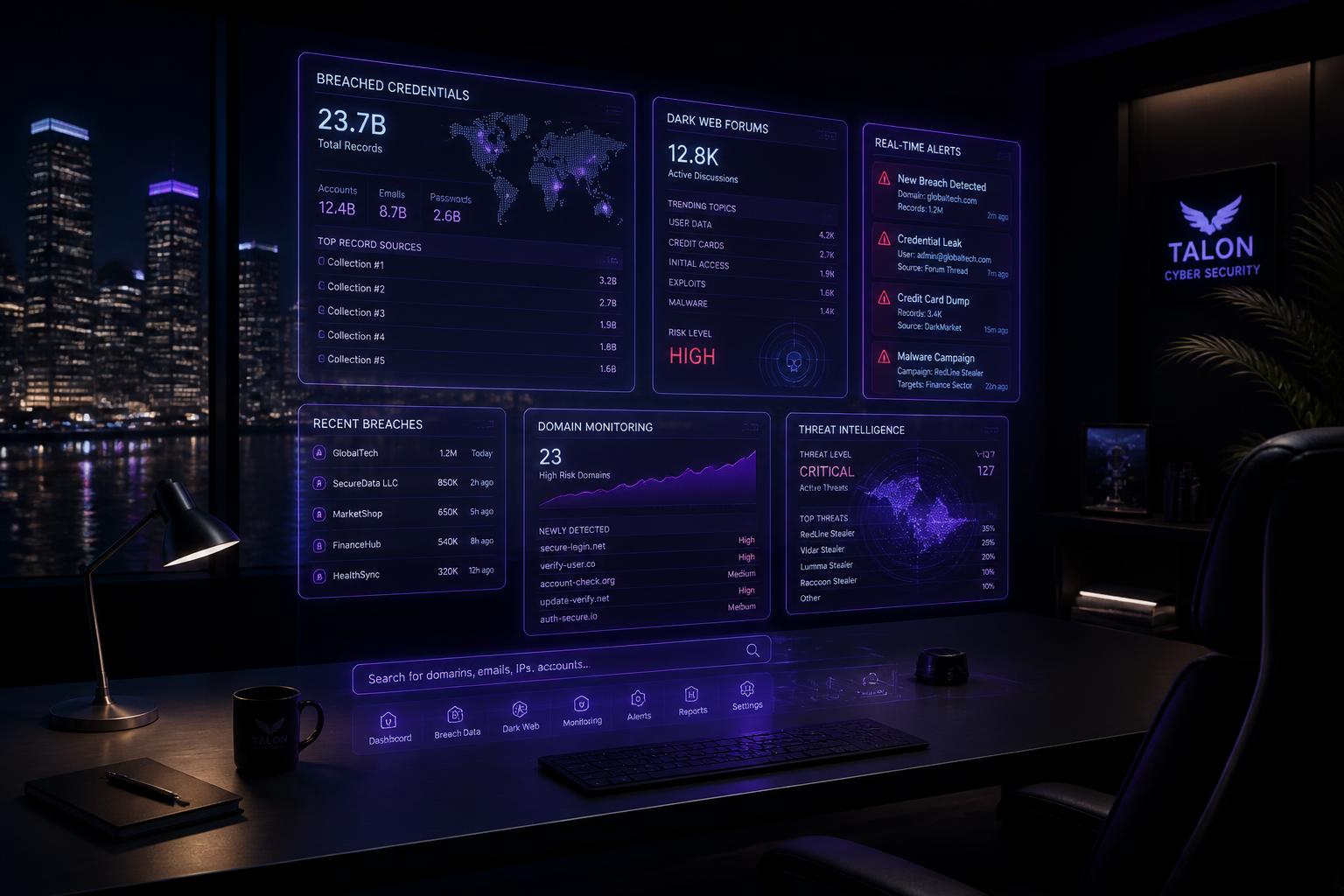
In 2026, the single most valuable asset on a criminal marketplace is not a zero-day exploit or a ransomware kit — it's a valid corporate credential. A working username and password for a Miami law firm's Microsoft 365 tenant sells for $3,000–$15,000 on initial access broker (IAB) forums. That same credential, purchased by a ransomware affiliate, becomes a $2M extortion event 30–60 days later. The window between 'your employee was infected' and 'your data is on a leak site' is measured in weeks, not years.
Dark web monitoring is how you close that window. Done right, it detects exposed credentials, leaked source code, stolen customer PII, and pre-attack chatter within hours — giving you the chance to force a password reset, revoke tokens, notify a customer, or engage incident response before the attacker cashes in. Done wrong (or not at all), you find out about the breach the same way everyone else does: when the ransomware note appears or the leak site countdown starts.
This is Cybrvault's 2026 field guide to dark web monitoring for businesses. We'll cover what it actually is, how it works under the hood, the tools professionals use, what a real monitoring program looks like, what it costs, and how to evaluate vendors. If you'd rather have us run monitoring for you, jump to Cybrvault dark web monitoring services at the bottom or book a consult.
What is dark web monitoring? (Precise definition.)
Dark web monitoring is the continuous, automated (and human-triaged) surveillance of underground and semi-public criminal ecosystems for mentions of your organization's identifiers — domains, email addresses, employee credentials, customer PII, executive names, brand assets, source code, API keys, and infrastructure — with real-time alerting when exposure is detected.
The name is slightly misleading. Modern 'dark web monitoring' does NOT limit itself to Tor hidden services (.onion sites). The actual monitored surface is much broader:
- Dark web (Tor / I2P) — ransomware leak sites, criminal marketplaces (Russian Market, 2easy, formerly Genesis), hacking forums (Exploit, XSS, BreachForums successors).
- Deep web — private forums behind registration/vetting walls, invite-only Discord and Telegram channels, criminal-adjacent Reddit communities.
- Clear web breach corpora — Have I Been Pwned, DeHashed, IntelX, LeakCheck, Snusbase (all indexed public breach data).
- Infostealer logs — RedLine, Vidar, Raccoon, Lumma, StealC malware output posted to Telegram channels and IAB marketplaces.
- Paste sites — Pastebin, GitHub Gists, DoxBin, Ghostbin (where credentials, doxes, and leaks land first).
- Ransomware leak sites — LockBit successors, ALPHV/BlackCat descendants, Cl0p, Play, Akira, Medusa dedicated leak sites (DLS).
- Typosquat and lookalike domain registrations — newly registered domains impersonating your brand (used for phishing and BEC).
- Criminal Telegram channels — the dominant 2026 marketplace for infostealer logs, combolists, and low-tier fraud.
Why it matters: the 2026 credential economy
Verizon's DBIR and every major incident response firm now report the same finding: the majority of breaches begin with a stolen or reused credential, not a zero-day exploit. The economics explain everything:
- An infostealer infection on a single employee laptop harvests every saved browser password, session cookie, autofill entry, crypto wallet, VPN config, and SSH key — often thousands of credentials from one machine.
- That log gets posted to a Telegram channel within hours, then sold in bulk to IABs for $10–$50.
- IABs sort logs by domain, sell corporate access to ransomware affiliates for $1,000–$50,000 depending on target revenue.
- The affiliate uses the credential to log into VPN, RDP, or M365, escalate privileges, exfiltrate data, and detonate ransomware — typically 3 to 30 days after the initial infection.
The window between step 1 (infection) and step 4 (ransomware) is your entire opportunity. Dark web monitoring is the tripwire that catches step 2 and lets you kill the credential before step 3 completes.
How dark web monitoring actually works (under the hood)
1. Ingestion
Monitoring platforms continuously ingest data from four source classes: (a) API integrations to breach corpora (HIBP, DeHashed, SpyCloud, IntelX), (b) automated crawlers on Tor and I2P forums and marketplaces, (c) Telegram channel scrapers that pull infostealer log posts in near real time, and (d) certificate transparency and DNS feeds for typosquat detection. Enterprise-grade vendors also run human collection — analysts with vetted forum personas who pull data that automated crawlers cannot reach.
2. Normalization and correlation
Raw feeds are messy — the same credential can appear in a 2019 breach, a 2024 combolist, and a 2026 infostealer log. Good platforms deduplicate, timestamp when the exposure first appeared, tag the source (breach vs. stealer vs. IAB), and correlate identifiers across sources (email → password → session cookie → machine fingerprint).
3. Matching against your assets
You give the platform your monitored assets: primary domain(s), executive email addresses, IP ranges, brand names, product names, source code repository names, and specific customer PII fields (for retail, healthcare, finance). The platform matches every incoming record against your asset list.
4. Alerting and triage
When a match is found, the platform generates an alert with the source, timestamp, evidence sample, and recommended action. Consumer tools stop here. Business-grade services add human analyst triage — because a hit in a 2016 LinkedIn breach is not the same emergency as a fresh RedLine infostealer log with a live M365 session cookie.
5. Response
The output feeds directly into your response playbook: force password reset, revoke session tokens, disable the account, notify the affected user, engage IR if there's evidence of active use, or file a takedown request against the leak site.
The professional dark web monitoring stack in 2026
There is no single tool that covers everything. Cybrvault's monitoring stack, and the stacks of every serious enterprise security team we work with, blends five categories:
Breach corpus APIs (foundation layer)
- Have I Been Pwned (HIBP) — Troy Hunt's canonical breach index. Free for personal use; the Enterprise domain search API is inexpensive and essential.
- DeHashed — searchable across billions of records; strong for email → password pivots.
- IntelX (Intelligence X) — deep archive with paste sites, leak dumps, and Tor content; strong historical coverage.
- SpyCloud — enterprise-grade with strong infostealer log coverage and post-breach analytics.
- LeakCheck / Snusbase — supplemental credential lookup services with unique dataset coverage.
Infostealer log intelligence (highest-value layer in 2026)
- Hudson Rock (Cavalier) — specialist in infostealer log analytics; identifies infected employees and third-party vendors.
- Flare — SaaS threat intel platform with strong Telegram and stealer log coverage.
- KELA — enterprise threat intelligence with deep IAB marketplace visibility.
- Recorded Future — enterprise-tier, includes stealer logs plus geopolitical threat intelligence.
Ransomware and leak site monitoring
- RansomLook, ransomware.live — free trackers of active ransomware leak sites (excellent for OSINT and public awareness).
- DarkOwl, Searchlight Cyber (DarkIQ) — commercial platforms with continuous DLS crawlers.
Brand and typosquat monitoring
- DNSTwist, URLCrazy — open source typosquat generators for continuous monitoring of lookalike domains.
- Dnsdb / DomainTools — passive DNS and WHOIS history for attribution.
- PhishTank, OpenPhish — community and commercial phishing URL feeds.
Orchestration
Alerts land in a SIEM (Microsoft Sentinel, Splunk, Elastic) or SOAR (Tines, Torq, Cortex XSOAR), where they trigger automated response — Azure AD password reset, session token revocation, Slack notification to the SOC, and case creation in the ticketing system.
What business-grade monitoring must cover (the seven data categories)
- 1Employee credentials — every corporate email address, every password exposure, every session cookie in an infostealer log.
- 2Executive PII — CEO, CFO, GC, board members monitored across personal emails, home addresses, and phone numbers (BEC and swatting prevention).
- 3Customer data — for retail, healthcare, finance, or law: your customer email domain patterns and any PII field patterns you can define.
- 4Source code and secrets — repository names, internal service names, API key formats, cloud account IDs (leaked GitHub repos are a top exposure vector).
- 5Infrastructure — corporate IP ranges, ASN, primary and dev/staging domains, internal SaaS tenant names.
- 6Brand assets — company name, product names, trademarks (for phishing and impersonation).
- 7Typosquat domains — real-time alerts on newly registered lookalike domains (phishing infrastructure is registered days before it's used).
Free vs. paid dark web monitoring (honest comparison)
Every consumer credit product now advertises 'dark web monitoring.' For personal use, the free tools are fine as a floor. For a business, they are dangerously incomplete.
Free tools (personal use is fine, business use is not)
- Google One / Google's dark web report — covers a small set of breach corpora, no infostealer logs, no leak sites, no forums.
- Have I Been Pwned — excellent free personal check, limited to indexed public breaches.
- Firefox Monitor — Mozilla's HIBP-based free scan.
- Experian / credit-bureau 'dark web scans' — marketing feature; extremely limited data coverage.
What free tools MISS: fresh infostealer logs (the #1 source of active corporate credential theft in 2026), IAB marketplace listings, ransomware pre-leak posts, private forum chatter, Telegram channel content, typosquat registrations, and human-analyst triage. If your business relies solely on free tools, you will find out about a breach at the same time your ransomware note arrives.
Paid business-grade monitoring
- SMB tier ($200–$500/month) — one domain, up to 10 executive emails, credential and infostealer monitoring, weekly analyst summary. Right for a 20–100 person firm.
- Mid-market ($500–$1,500/month) — multiple domains, 25+ executives, brand and typosquat monitoring, ransomware leak-site coverage, monthly review call. Right for 100–500 person firms.
- Enterprise ($1,500–$10,000+/month) — full attack surface, source code / secrets monitoring, human collection on private forums, 24/7 SOC-integrated alerting, IR retainer. Right for regulated industries (finance, healthcare, legal, defense).
How to actually respond when you get a hit
An alert without a playbook is a notification, not security. Every business-grade monitoring program should be paired with a written response playbook. Cybrvault's baseline runbook:
- 1Verify the hit is fresh and real. Check the source date and dedupe against prior alerts.
- 2Reset the credential immediately across every system the user touches, especially SSO / M365 / Google Workspace / VPN.
- 3Revoke all active sessions and tokens — a stolen session cookie bypasses MFA until it's explicitly revoked.
- 4Force MFA re-enrollment if the exposure includes MFA seed or session tokens.
- 5Rotate any API keys, SSH keys, or service credentials stored on the same machine (assume the whole browser vault is compromised).
- 6Isolate and re-image the source machine if the exposure came from an infostealer log — the malware is still resident until proven otherwise.
- 7Notify the affected user with a scripted message that explains what happened without inducing panic.
- 8Log the incident and file it in your compliance record (this is a reportable event under some frameworks).
- 9If evidence of active use exists (logins from unfamiliar geographies, mail forwarding rules, MFA method changes), engage full incident response immediately.
Legal, ethical, and compliance considerations
Dark web monitoring lives in a well-defined legal zone when done correctly. Passive collection of publicly (or criminally-publicly) available data does not violate the CFAA. Purchasing stolen data, actively soliciting compromise, or paying ransoms crosses lines. A few 2026 realities:
- Do not buy stolen data. Reputable monitoring firms collect from public leaks and criminal-adjacent forums without purchasing stolen credentials or paying threat actors.
- Do not scrape platforms in ways that violate ToS as unauthorized access. The CFAA line is narrow; leave forum access to firms with vetted personas and legal review.
- Handle exposed customer PII lawfully. In Florida, exposed customer records may trigger notification duties under FIPA (Florida Information Protection Act) within 30 days. Federally, HIPAA, GLBA, and sector rules apply.
- Preserve chain of custody on findings you may need to hand to law enforcement or use in litigation. Same requirements as OSINT: source URL, timestamp, screenshot hash, tool version, analyst declaration.
- GDPR / CCPA / FCRA apply if you're using breach data to make decisions about individuals (employment, credit). Get counsel before doing so.
How to evaluate a dark web monitoring vendor
Ten questions to ask any provider before you sign:
- 1Which specific data sources do you monitor? (Want to hear infostealer logs, Telegram, ransomware DLS, IAB marketplaces — not just 'the dark web.')
- 2How fresh is your data? (Real answer: infostealer log detection within 24–72 hours of posting.)
- 3Do you use human analysts for triage, or is every alert automated?
- 4How do you handle false positives from old / recycled breach data?
- 5Do you monitor executive PII across personal identifiers, or corporate emails only?
- 6Do you cover typosquat and impersonation domains?
- 7What's the SLA on high-severity alerts?
- 8Do you integrate with our SIEM / SOAR / ticketing?
- 9Do you provide incident response when exposure indicates active compromise?
- 10Can you show a redacted sample report?
Common questions we get in Miami
A quick set of answers to what business owners in South Florida ask us on discovery calls. The full FAQ is at the bottom.
- Is dark web monitoring worth it for a 25-person firm? Yes. The most cost-effective control we deploy at that size. One credential caught early routinely prevents a five-to-seven-figure incident.
- Will monitoring get us hacked or attract attention? No. Passive monitoring generates no signal on the target side.
- Do we need this if we already have MFA? Yes. Session cookies from infostealer logs bypass MFA. MFA is necessary; it is not sufficient.
- How fast will you tell me? Cybrvault's SLA is 24 hours for high-severity credential exposure, faster for active-use indicators.
Cybrvault dark web monitoring services
Cybrvault provides 24/7 dark web and threat intelligence monitoring for Miami and South Florida businesses — law firms, family offices, healthcare, real estate, finance, and DoD contractors. Every engagement includes: continuous monitoring of your corporate domain, executive emails, employee credentials, customer data patterns, source code repositories, brand mentions, and typosquat domains; human-analyst triage on every high-severity alert; a written response playbook tailored to your stack; and same-day incident response when exposure indicates active use.
We combine the same enterprise data sources used by Fortune 500 SOCs (SpyCloud-tier stealer log intelligence, DarkOwl-tier forum coverage, RansomLook DLS monitoring, real-time Telegram scraping) with local analyst attention that a $1M/year enterprise contract cannot deliver. Pricing starts at $299/month for SMB and scales with your monitored surface.
Related Cybrvault services: Miami cybersecurity consulting, OSINT investigations, 24/7 monitoring & MDR, and small business cybersecurity. If you've already been hit or suspect exposure, book a confidential consult — we typically triage new engagements within one business day.
Get the 10-step Cyber Hardening Checklist
The exact steps our Miami team uses to lock down people and small businesses — takes under an hour. Instant access, no call required.
// frequently asked
Questions teams ask us
What is dark web monitoring?+
Dark web monitoring is the continuous surveillance of underground forums, criminal marketplaces, ransomware leak sites, breach corpora, paste sites, and Telegram channels for mentions of your organization's identifiers — domains, emails, credentials, PII, source code, brand assets — with real-time alerting when exposure is detected. Business-grade monitoring covers infostealer logs and initial access broker marketplaces, which is where most modern credential theft actually shows up.
How does dark web monitoring work?+
Monitoring platforms continuously ingest data from breach corpora APIs, Tor and I2P crawlers, Telegram channel scrapers, and human-collected forum content. Records are normalized, deduplicated, and matched against your monitored assets. When a match is found, an alert is generated with source, timestamp, and evidence. In business-grade services, a human analyst triages the alert before it reaches your team, and the response playbook triggers automated actions (password reset, session revocation, MFA re-enrollment).
Is dark web monitoring worth it for a small business?+
Yes. Credential-driven breaches average $250k+ in direct cost for SMBs in 2026, and 80%+ of breaches start with a stolen or reused credential. A business-grade monitoring service starts at ~$200–$300/month for a small firm — routinely catches at least one high-severity credential exposure per year that would otherwise become a ransomware incident. It is one of the highest-ROI security controls a small business can deploy.
What is the difference between free and paid dark web monitoring?+
Free tools (Google's dark web report, Have I Been Pwned, Firefox Monitor, credit bureau scans) check a small set of indexed public breaches. They miss infostealer logs (the #1 source of active corporate credential theft in 2026), initial access broker marketplaces, ransomware pre-leak posts, private forum chatter, Telegram content, typosquat registrations, and human analyst triage. Free tools are fine for personal use; they are not sufficient for business protection.
Does dark web monitoring bypass MFA?+
No — but modern threats do. Infostealer malware harvests session cookies alongside passwords, and a valid session cookie bypasses MFA until it is explicitly revoked. That's why dark web monitoring must feed into a response playbook that revokes active sessions on every alert, not just resets the password. MFA is necessary but not sufficient in 2026.
How much does dark web monitoring cost for a business?+
SMB tier is $200–$500/month for one domain and ~10 executives. Mid-market is $500–$1,500/month for multiple domains, brand and typosquat monitoring, and ransomware leak-site coverage. Enterprise runs $1,500–$10,000+/month for full attack surface monitoring, source code and secrets watch, human forum collection, and 24/7 SOC-integrated alerting. Cybrvault's Miami SMB pricing starts at $299/month.
Is dark web monitoring legal?+
Yes, when done correctly. Passive collection of publicly (or criminally-publicly) available data does not violate the CFAA. Reputable providers do not purchase stolen data, do not pay threat actors, and do not access private forums in ways that constitute unauthorized access. If a vendor is vague about how they collect, that is a red flag.
How fast should I be notified when my credentials show up on the dark web?+
For high-severity exposure (fresh infostealer log with active session cookies, active IAB listing for your domain), a good vendor delivers a triaged alert within 24 hours of posting. For lower-severity historical breach reappearance, weekly summary is fine. Ask any prospective vendor for their SLA in writing.
What should I do if my company shows up in a dark web monitoring alert?+
Follow a written playbook: verify the hit is fresh, reset the affected credential immediately across all systems, revoke all active sessions and tokens, force MFA re-enrollment, rotate API and SSH keys stored on the same machine, isolate and re-image the source device if it was an infostealer infection, notify the affected user, log the incident, and engage incident response if there is evidence of active use. Never treat an alert as informational — treat it as an active credential compromise until proven otherwise.
// miami, fl services
Cybersecurity built for South Florida
// need help applying this?
Book a free, confidential consultation.
Our engineers can map this to your environment in 30 minutes.
Get secured// keep reading
Related articles

Personal Security
Best Cybersecurity Practices for Individuals: 2026 Guide
Follow a practical, prioritized personal cybersecurity checklist for safer accounts, devices, home Wi-Fi, finances, travel, family communications, and recovery.

Home Security
Home Cyber Security Services in Miami: 2026 Guide
Learn what professional home cyber security services protect, what a Miami residential assessment includes, and how to choose qualified help for your household.

Personal Security
Personal Cyber Security Services in Miami: 2026 Guide
A practical guide to personal cyber security services in Miami for individuals, families, executives, and professionals—including device, account, privacy, home network, and incident protection.
Under attack right now? Our 24/7 line responds immediately.