
Ethical Hacking
Red Team vs Blue Team in Cybersecurity: The 2026 Guide for Miami Businesses
Red team vs blue team — what each side actually does, how they work together (purple teaming), and how Miami businesses use both to stress-test defenses in 2026. Real engagement examples, pricing, FIPA/HIPAA fit, and how to know which one you need first.
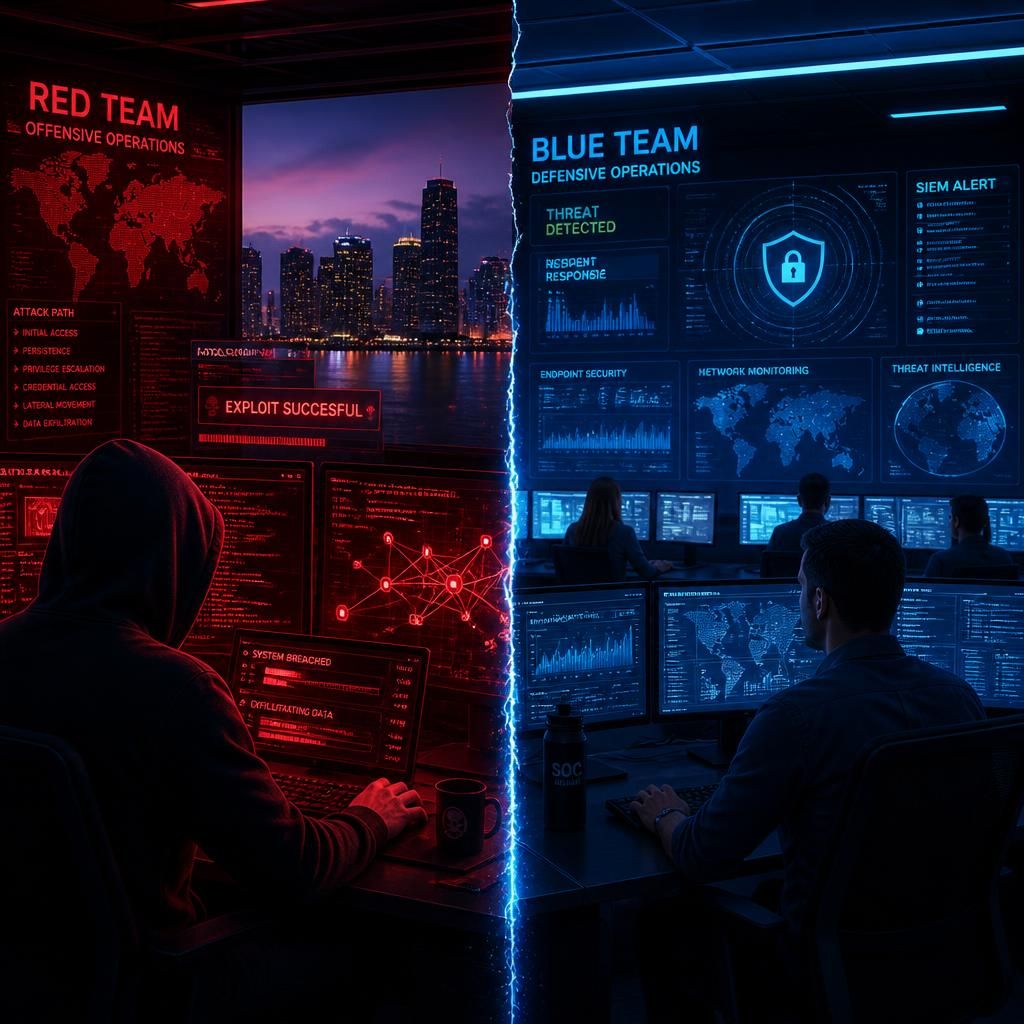
If you've talked to a cybersecurity vendor in Miami in the last year, you've probably heard the terms red team and blue team thrown around like everyone knows what they mean. They don't. Even IT directors get them mixed up with pen testing, vulnerability scanning, or 'that thing our SIEM does.' This guide fixes that — in plain English, with real Miami engagement examples, 2026 pricing, and a clear answer to the question everyone is really asking: which one do I need first?
The Short Answer
- Red team = the attackers. Ethical hackers who simulate a real adversary end-to-end — phishing, exploitation, lateral movement, data exfiltration — usually without your IT team knowing when.
- Blue team = the defenders. The people and tools that detect, contain, and respond to attacks: SOC analysts, SIEM, EDR/XDR, threat intel, incident response.
- Purple team = both sides sitting in the same room, running attacks openly and improving detections in real time. This is where most measurable improvement happens.
What a Red Team Actually Does
A red team engagement is objective-based: the client says 'get to the payroll system,' 'exfiltrate the patient database,' or 'become domain admin,' and the red team does whatever a real attacker would do to make that happen — inside a written rules-of-engagement document. It is not a vulnerability scan with a fancy name.
Typical red team playbook (2026)
- 1Reconnaissance: OSINT on the company, employees, Miami office locations, exposed cloud assets, GitHub leaks.
- 2Initial access: targeted spear phishing, a rogue Wi-Fi drop near the Brickell office, an MFA-fatigue push storm, or a supply-chain foothold through an MSP.
- 3Establish persistence: implant a beacon, create a hidden account, abuse OAuth consent in Microsoft 365.
- 4Privilege escalation & lateral movement: Kerberoasting, token theft, Entra ID abuse, jumping from a user laptop to a domain controller or cloud tenant.
- 5Objective completion: exfil the crown jewels the client defined, without triggering the SOC.
- 6Report & debrief: a full attack narrative, timeline, MITRE ATT&CK mapping, and every detection opportunity that was missed.
A serious red team runs 3–8 weeks, is usually white-carded to two people at the client (the CISO and one exec), and costs $18,000–$75,000+ in South Florida depending on scope and whether physical intrusion or social engineering of specific people is in play.
What a Blue Team Actually Does
The blue team is the day-to-day machine that keeps you from being tomorrow's breach headline. Where the red team shows up for a few weeks a year, the blue team is on the clock 24/7/365 — which is why most Miami small and mid-size businesses outsource it as MDR (Managed Detection & Response) rather than trying to staff three shifts of analysts.
Core blue team responsibilities
- Detection engineering — writing and tuning SIEM rules, EDR policies, and cloud-audit alerts against MITRE ATT&CK.
- Triage & investigation — 24/7 eyes-on-glass, following runbooks, escalating true positives within minutes.
- Incident response — containment (isolating hosts, disabling accounts), eradication, recovery, and post-incident reporting.
- Threat hunting — proactively looking for adversary behavior the tools didn't alert on.
- Vulnerability & patch management — continuous scanning and prioritized remediation.
- Purple-team readiness — validating detections against real attacker TTPs on a schedule.
Blue team pricing for Miami SMBs typically runs $1,500–$6,000/month for outsourced MDR, or a fully in-house SOC starting around $650,000/year loaded (three analysts + tools + tier-2/3 lead). See 24/7 SOC monitoring for how we deliver this locally.
Red Team vs Blue Team vs Pen Test vs Vuln Scan
These terms get sold interchangeably, and they shouldn't be. Here's the cleanest way to keep them straight:
- Vulnerability scan — automated tool (Nessus, Qualys) finds known weaknesses. Days. Hundreds to low thousands of dollars. Broad, shallow, noisy.
- Penetration test — a human exploits a defined scope (app, network, cloud) to prove impact. 1–3 weeks. $8,000–$45,000. Depth over breadth. See penetration testing in Miami.
- Red team — objective-based simulation of a real threat actor across people, process, and tech. 3–8+ weeks. $18,000–$75,000+. Tests your detection and response, not just your walls.
- Blue team / MDR — ongoing 24/7 defense. Monthly recurring. The thing that catches the other three.
Purple Teaming: Where the Real ROI Is
Purple teaming is not a third team — it's a working mode. Red and blue sit together, red executes a known ATT&CK technique (say, T1055 Process Injection), blue watches whether their EDR, SIEM, or MDR provider caught it, and if not, they write the detection right then. In one afternoon a Miami mid-market company can validate coverage against 15–30 techniques and walk away with measurable improvement.
Cybrvault runs purple team days for South Florida clients as a $6,500 fixed-fee engagement: 1 day of prep, 1 day live, 1 day of report and detection tuning. It's the fastest way to know whether the SOC or MDR you're paying for is actually earning its retainer.
Which One Does a Miami Business Need First?
The order matters. Skipping it wastes money.
- 1Blue team first (always). If nothing detects or responds, hiring a red team is theater — you'll get a report that says 'we got in' with no learning loop. Stand up EDR, ship logs to a SIEM or MDR, and write a written incident response plan. Cybrvault's Miami SOC monitoring covers this end-to-end.
- 2Then run a pen test. Once you have detections, prove which controls hold up against a scoped human attacker. Fix the findings.
- 3Then purple team. Validate that your blue team can see modern TTPs, not just the ones vendors marketed to them.
- 4Then, and only then, red team. When you can honestly answer 'yes, we'd catch a real intrusion,' pay a red team to prove it. If they still get in silently, you have a specific, actionable list of blind spots.
Why This Matters in Miami Specifically
South Florida is a target-rich environment: family offices in Coral Gables, crypto and fintech in Brickell, healthcare across Miami-Dade, DoD subcontractors near Homestead, and a very high concentration of high-net-worth individuals whose personal devices touch corporate networks. Threat actors know this. In 2026 we've responded to Miami incidents involving AI voice-cloning wire fraud, OAuth consent phishing against Microsoft 365, MFA-fatigue attacks on Entra ID admins, and old-fashioned physical drops of malicious USBs at conferences in Miami Beach.
Miami companies also have a compliance overlay most other markets don't: FIPA (Florida Information Protection Act) requires notification within 30 days of a breach — meaning your blue team's detection speed has a legal deadline attached. HIPAA, PCI, SOC 2, and CMMC all expect documented adversary simulation as evidence.
Frameworks We Use
- MITRE ATT&CK v15 — the shared language between red and blue.
- MITRE D3FEND — defensive countermeasures mapped 1:1 to ATT&CK techniques.
- NIST CSF 2.0 (Detect, Respond, Recover functions) — governance and reporting.
- TIBER-EU / CBEST-style threat-led scoping — for financial services in Brickell.
- PTES & OWASP WSTG — pen test methodology inside red team engagements.
What a Red Team Engagement Costs in Miami (2026)
- Focused red team (network + phishing, 3 weeks): $18,000 – $32,000
- Full-scope red team (phishing + web + cloud + AD, 5–6 weeks): $35,000 – $60,000
- Assumed-breach red team (fastest ROI): $22,000 – $40,000
- Physical + social engineering add-on (Miami office walk-in, badge cloning): +$8,000 – $15,000
- Purple team day: $6,500 fixed
- MDR (blue team, outsourced): $1,500 – $6,000 per month depending on headcount and log volume
10 Questions to Ask a Miami Red Team Vendor
- 1Show me a redacted red team report — not a pentest report — from the last 12 months.
- 2Who is on the team, and what are their certs? (OSEP, OSCE3, CRTO, CRTP, CBBH, GXPN carry weight; OSCP alone does not = red team.)
- 3What's your policy on custom tradecraft vs off-the-shelf tools like Cobalt Strike or Sliver?
- 4How do you handle detection avoidance without breaking the client's production environment?
- 5Do you write custom malware/loaders for the engagement, or reuse public payloads?
- 6How is white-carding handled, and who at my company will know?
- 7What's your rules-of-engagement template, and how do we handle a live-fire incident during the op?
- 8How do you map findings to MITRE ATT&CK and hand them off to my blue team or MDR?
- 9Do you carry professional liability and cyber insurance? What limits?
- 10Can you provide 3 South Florida references in my industry?
How Cybrvault Runs Red and Blue Teams in Miami
Cybrvault is a Miami-headquartered cybersecurity firm. Our red team is senior-only (no interns, no offshoring), engagements are objective-based against MITRE ATT&CK, and every report ships with a purple-team workshop so your blue team or MDR provider walks away with tuned detections — not just a PDF.
On the defensive side, our 24/7 SOC monitoring service acts as an outsourced blue team for Miami-Dade, Broward, and Palm Beach businesses: MDR on top of your existing EDR, SIEM tuning, threat hunting, and incident response with a 15-minute triage SLA.
Related services: Miami ethical hacking / pen testing · Cybersecurity audits · Miami cybersecurity · OSINT investigations.
Book a Red or Blue Team Assessment in Miami
If you're not sure which side of the house you should invest in next — or you want an honest gap analysis before writing a check — a scoping call is free. Contact Cybrvault to schedule 30 minutes with a senior engineer.
Get the 10-step Cyber Hardening Checklist
The exact steps our Miami team uses to lock down people and small businesses — takes under an hour. Instant access, no call required.
// frequently asked
Questions teams ask us
What's the difference between a red team and a penetration test?+
A pen test is scope-based: you hand a vendor a defined target (a web app, an internal network, a cloud tenant), they exploit it in 1–3 weeks, and they hand back a list of vulnerabilities with impact. A red team is objective-based: you give them a goal (become domain admin, exfil the patient database) and they use whatever a real attacker would use — phishing, physical, cloud, third-party — across 3–8+ weeks, specifically to test whether your blue team can detect and respond. Pen tests answer 'can this be broken?' Red teams answer 'would we know if it was?'
Do small Miami businesses actually need a red team?+
Usually not yet. Under ~150 employees, the money is almost always better spent on blue-team foundations: EDR, MDR/SOC coverage, a written IR plan, MFA everywhere, and an annual pen test. Red teaming pays off once you already have detection and response in place — otherwise you're paying for a report that says 'we got in' with no way to improve. If you're a Miami SMB, start with [24/7 SOC monitoring](/miami/24-7-monitoring) and a scoped [pen test](/blog/penetration-testing-miami-2026-guide) first.
What is purple teaming and is it worth it?+
Purple teaming is red and blue working in the same room instead of adversarially. Red executes known attacker techniques (mapped to MITRE ATT&CK), blue watches whether their tools caught it, and when they didn't, the detection gets written on the spot. It's the highest-ROI exercise for a mid-market Miami company that already has a SOC or MDR — you can validate coverage of 15–30 techniques in a single day and leave with measurable improvement. Cybrvault runs these as $6,500 fixed-fee engagements.
How long does a red team engagement take?+
A focused red team (phishing + network) runs 3 weeks. A full-scope engagement covering phishing, web, cloud, and Active Directory typically runs 5–6 weeks. Assumed-breach engagements (where the red team starts with a foothold to skip the initial-access phase) are faster and cheaper at 2–3 weeks. Add another 1–2 weeks if physical intrusion or targeted social engineering of specific executives is in scope.
Can Cybrvault provide both red team and blue team services?+
Yes, and we deliberately keep them independent. Our red team is a separate practice from our SOC/MDR team — the offense doesn't tip off the defense during engagements, which is the whole point of a real adversary simulation. Many Miami clients use us for both: outsourced blue team (MDR) as the always-on layer, and periodic red team or purple team engagements to validate the coverage.
How does red team vs blue team work with FIPA and HIPAA in Florida?+
FIPA gives Florida businesses 30 days to notify affected residents after a breach is discovered — detection speed is a legal deadline, which is a blue-team problem. HIPAA §164.308(a)(8) requires periodic technical evaluation, and adversary simulation (pen test or red team) is the accepted evidence. Most Miami healthcare, fintech, and DoD-adjacent clients run an annual pen test, a purple-team day every 6 months, and a full red team every 18–24 months, all backed by continuous MDR — that combination satisfies auditors and insurers, and materially reduces dwell time when something real happens.
// miami, fl services
Cybersecurity built for South Florida
// need help applying this?
Book a free, confidential consultation.
Our engineers can map this to your environment in 30 minutes.
Get secured// keep reading
Related articles

Ethical Hacking
Penetration Testing in Miami: The 2026 Buyer's Guide for Businesses & Ethical Hacking Teams
A local, no-fluff guide to penetration testing in Miami — what a real pentest looks like in 2026, how ethical hackers scope engagements, pricing, FIPA and HIPAA fit, and the questions that separate a real Miami pen test from a Nessus scan with a logo.

Ethical Hacking
Ethical Hacking Services in Miami: A Legal Guide for Businesses (2026)
Learn how legal ethical hacking services help Miami businesses find exploitable security gaps, what written authorization must cover, which tests to request, and how to hire a legitimate provider.

Cybersecurity
How to Prevent Ransomware in 2026: The Miami Business Owner's Playbook
A field-tested 2026 ransomware prevention playbook from a Miami cybersecurity firm — the six attack vectors that actually hit South Florida businesses this year, the exact controls that stop them, and the 30-day hardening plan we run for clients before the encryption starts.
Under attack right now? Our 24/7 line responds immediately.