
Home Security
Home Title Theft in Miami (2026): How Deed Fraud Really Works and How to Protect Your Property
Home title theft is a real, documented crime in Florida — and Miami-Dade is one of its busiest markets. Here's exactly how a forged deed gets recorded, the free county alerts every homeowner should enroll in today, the warning signs of a stolen title, and the step-by-step recovery process if it happens to you.
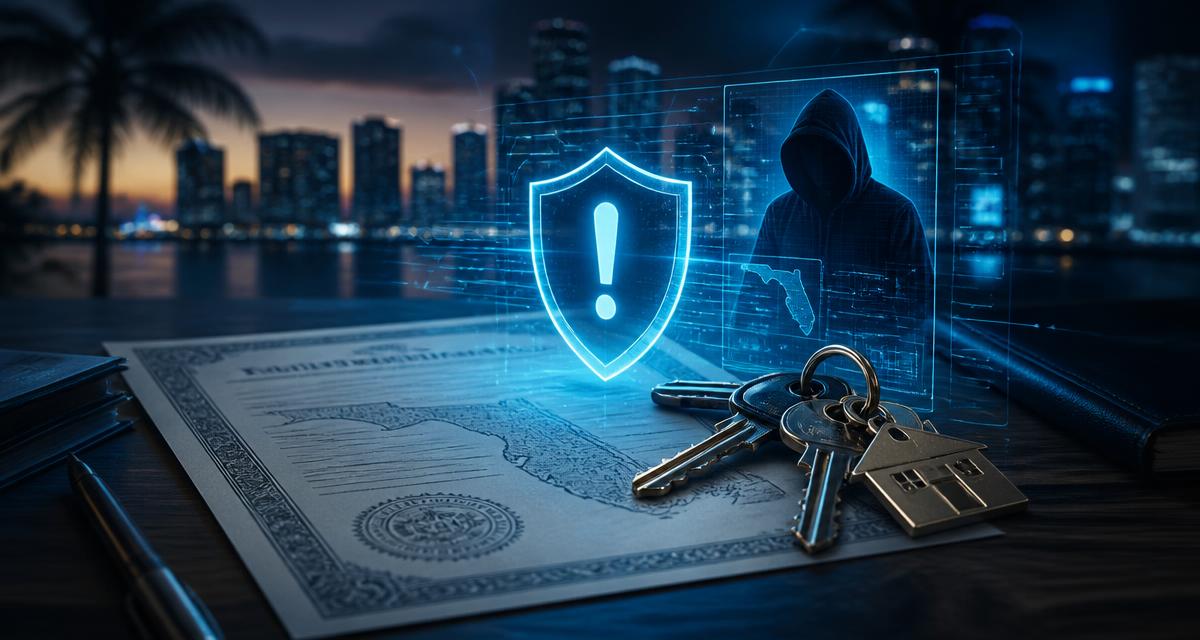
If you own property in Miami-Dade, you have almost certainly heard a radio ad warning that criminals can steal your home with a few keystrokes. The ads are alarmist and the product they sell is often misunderstood — but the underlying crime is real, it is prosecuted in Florida every year, and South Florida's mix of high property values, absentee owners, seasonal residents and heavy investor activity makes it one of the country's more active markets for it.
This guide explains what home title theft actually is, how the fraud is executed step by step, which South Florida properties are targeted, the free county tools that catch it early, what the paid services do and don't do, and the exact recovery sequence if a forged deed shows up on your property.
What is home title theft?
Home title theft — more precisely called deed fraud — is when someone forges a deed transferring ownership of your property to themselves or a shell entity, and records that forged document with the county. Once recorded, the public record shows a new owner. The criminal then monetizes the position: taking out a home equity loan against the property, selling it to an unsuspecting buyer, or renting it out and collecting deposits before disappearing.
Two things are worth understanding clearly, because they cut through most of the marketing fear:
- A forged deed does not legally transfer ownership. Florida courts treat a forged deed as void — it conveys nothing. You do not lose your house because a fraudulent document was recorded. What you lose is time, legal fees, and the ability to sell or refinance until the record is cleaned up.
- The fraud requires a recorded public document. That is the vulnerability and also the defense: because the recording is public and time-stamped, county notification systems can alert you within a day of a document being filed against your address.
The damage is real even though the transfer is void. Homeowners have discovered the fraud only when a foreclosure notice arrived for a loan they never took, or when a buyer showed up to inspect a home they believed they had purchased. Unwinding it typically takes months and a quiet-title lawsuit.
How deed fraud is actually executed
The process is unglamorous and largely clerical. Understanding the sequence is what makes the defenses obvious.
- 1Target selection. The criminal searches public property appraiser records for properties that look unwatched: no mortgage on record, an out-of-state mailing address, an estate or trust as owner, a vacant lot, or a homestead exemption that was recently removed. All of this is free and public.
- 2Owner research. Data brokers, obituaries, social media and old breach data fill in the owner's full legal name, date of birth, prior addresses and sometimes a partial Social Security number. For deceased or elderly owners, the obituary is often the trigger event.
- 3Document preparation. A Florida quitclaim or warranty deed is prepared naming the real owner as grantor and the criminal, an accomplice, or an LLC as grantee. The forms are freely available.
- 4Notarization. This is the weak link the entire crime depends on. The signature is forged and the notarization is either fabricated outright, obtained through a complicit notary, or — increasingly since 2020 — pushed through a remote online notarization session using stolen or synthetic identity documents.
- 5Recording. The deed is submitted to the county recorder, often electronically. Recorders perform a facial and statutory review of the document, not an identity investigation. If the form is correct and the fee is paid, it gets recorded.
- 6Monetization. With the record showing new ownership, the criminal applies for a home equity loan, lists the property for a fast cash sale below market, or rents it out. Speed matters to them — they want to be liquid before anyone notices.
"In every case we have reviewed, the county recording was the loudest possible signal — filed publicly, on a specific date, against a specific parcel. The owner simply had no alert configured to hear it."— Cybrvault investigations team
Which Miami-Dade properties are targeted most
South Florida has a specific risk profile. If any of these describe your situation, treat this guide as urgent rather than informational:
- Free-and-clear properties. No mortgage means no servicer sending escrow statements and no lender watching the title. Paid-off homes — common among long-time and retired Miami owners — are the single most targeted category.
- Inherited and estate properties. Probate is slow, ownership is ambiguous on paper, and the obituary publicly announces that the owner can no longer object.
- Seasonal and second homes. Snowbird properties in Aventura, Sunny Isles, Key Biscayne and Coral Gables sit empty for months. Mail piles up or is forwarded, and nobody drives by.
- Vacant land. No structure, no utilities, no neighbors — deed fraud on vacant lots can go undetected for years.
- Out-of-state and foreign owners. Miami's large base of international owners frequently uses a mailing address abroad, so physical mail notices never arrive in time.
- LLC and trust-held property. Corporate ownership records make it easier to fabricate a plausible transfer document and harder for a recorder to spot something off.
- Elderly homeowners. Longer tenure, more equity, more public records, and a higher likelihood that the fraud is discovered late.
Warning signs your title may have been touched
Deed fraud rarely announces itself. These are the signals that show up first:
- Property tax bills, TRIM notices or utility statements stop arriving — a change-of-address on the parcel record is a common precursor.
- Mail arrives addressed to a name you don't recognize at your property address.
- You receive loan documents, HELOC paperwork or a foreclosure notice for financing you never applied for.
- The property appraiser's site shows a name, mailing address or sale you don't recognize.
- Your homestead exemption is unexpectedly removed or denied — a transfer of record can trigger this.
- Strangers appear for a showing, inspection or appraisal you did not schedule.
- A credit report shows a mortgage inquiry or new secured loan tied to your address.
If you see any of these, do not wait for a second signal. Pull the official record for your parcel the same day.
The free protections every Miami homeowner should enroll in today
This is the part the radio ads leave out. Florida counties offer recording notification for free. If you do nothing else from this guide, do this:
- 1Miami-Dade — Owner Alert. The Miami-Dade Property Appraiser operates a free Owner Alert service that emails you whenever a document is recorded that changes ownership of your parcel. Enroll with your folio number and email at miamidade.gov/pa.
- 2Miami-Dade — Recorder notifications. The Clerk of the Court's official records system also lets you monitor filings against your name. Search your own name and set up alerts through the Clerk's official records portal.
- 3Broward County. The Broward Clerk offers a free Property Fraud Alert notifying you when documents are recorded under your name — worth enrolling for any Broward property you own.
- 4Palm Beach County. The Clerk & Comptroller runs a comparable free property fraud alert program.
- 5Enroll for every parcel and every name variant. Register your full legal name, any maiden or former name, and each LLC or trust that holds property. Alerts are keyed to names and parcels, so a missing variant is a blind spot.
- 6Use an email address you actually monitor — and secure it. An alert sent to an abandoned inbox protects nobody.
These services are notification, not prevention. Nothing stops a criminal from submitting a document. What they buy you is time: catching a fraudulent recording in 24 hours instead of 18 months is the difference between a letter from your attorney and a year-long quiet-title action.
Are paid 'home title lock' services worth it?
Straight answer: they do not lock anything. There is no mechanism in Florida law by which a private company can freeze your county's ability to record a document. What these subscriptions provide is monitoring — the same category of service your county provides free — plus, on higher tiers, restoration assistance and a legal expense allowance.
They can make sense if:
- You own property across multiple counties or states and want one consolidated alert feed rather than five separate enrollments.
- You want bundled legal expense coverage for the restoration process and have read exactly what the policy pays for.
- You will genuinely not enroll in the free county alerts — imperfect coverage beats none.
They are not a substitute for an owner's title insurance policy, which is what actually protects your ownership interest against defects and certain forgeries. If you bought your Miami home with a mortgage, the lender's policy protected the lender — check whether you also purchased an owner's policy. Many buyers did not.
The digital layer: where title fraud actually starts
Deed fraud is a paper crime with a data supply chain. Every case starts with the criminal knowing who you are, what you own, and that nobody is watching. That information comes from the same places we spend our days shutting down for private clients.
Data brokers and people-search sites
Sites like Whitepages, Spokeo, BeenVerified and dozens of smaller aggregators publish your full name, age, current and prior addresses, relatives and phone numbers in one convenient profile. Removing yourself from these sites — and re-checking every few months, because profiles regenerate — removes the research step. Our personal cybersecurity guide for Miami business owners walks through the removal process in detail.
Your email account is the master key
A compromised inbox gives an attacker your closing documents, your lender correspondence, your attorney's contact details and the ability to intercept notices — including county fraud alerts. Every property owner should have a passkey or hardware-key-backed second factor on their primary email. See passkeys vs passwords for the setup we recommend.
Real estate wire fraud is the adjacent threat
If you are actively buying or selling in Miami, the more probable and more expensive attack is business email compromise against the closing: a spoofed message from 'the title company' redirecting your down payment to a criminal account. Never accept wiring instructions by email. Call the title company at a number you independently looked up and verbally confirm every digit before sending funds. Our business email compromise breakdown covers exactly how these are staged.
Credit freezes close the identity loop
A criminal who records a deed still needs to pass underwriting to borrow against it. A security freeze at Equifax, Experian and TransUnion — free, and reversible in minutes — blocks the new-credit step that makes the whole scheme profitable.
A 12-point title protection checklist for South Florida owners
- 1Enroll every parcel in the free Miami-Dade Owner Alert (and Broward or Palm Beach equivalents for other holdings).
- 2Register every name variant and every LLC or trust that appears on a deed you own.
- 3Look up your parcel on the property appraiser's site today and confirm the owner name and mailing address are correct.
- 4Search the Clerk's official records for your name and read every document recorded against you in the last three years.
- 5Confirm you hold an owner's title insurance policy — find the actual policy document, not just the closing folder.
- 6Freeze your credit at all three bureaus.
- 7Enable passkey or hardware-key two-factor on your primary email, then on your banking and county portal accounts.
- 8Remove your profile from the major people-search and data-broker sites, and set a calendar reminder to re-check quarterly.
- 9Never let mail accumulate at a seasonal property — use a hold, a trusted neighbor, or a monitored mailbox service.
- 10Drive by or have someone check vacant land and unoccupied properties on a set schedule.
- 11For estate and inherited property, complete probate and record the corrective deed promptly rather than leaving ownership ambiguous.
- 12Verify any wiring instructions verbally, at an independently sourced phone number, before every real estate transaction.
What to do if a fraudulent deed has been recorded
Speed matters. Every week a forged deed sits on record, more downstream transactions — loans, liens, sales to good-faith purchasers — attach to it and make the cleanup harder.
- 1Obtain the recorded document. Pull the certified copy from the Miami-Dade Clerk's official records. You need the instrument number, recording date, grantee name and the notary's name and commission number.
- 2Retain a Florida real estate attorney immediately. This is not a self-service process. The remedy is typically a quiet-title action to have the forged deed declared void and removed from the chain of title.
- 3File a police report. Contact Miami-Dade Police economic crimes and get a case number — you will need it for the county, your title insurer and any lender involved.
- 4Notify the Clerk and the Property Appraiser in writing that the recording is fraudulent, and ask what corrective filing or notice-of-fraud process is available.
- 5Report to the state. Filing a false document affecting real property is a felony under Florida Statute 817.535; the State Attorney's office and the Florida Attorney General's consumer protection division should both receive a report.
- 6Report to federal authorities. File with the FBI's Internet Crime Complaint Center at ic3.gov and with the FTC at identitytheft.gov, which generates a recovery plan and an official identity theft report.
- 7Contact your title insurer. If you hold an owner's policy, open a claim — forgery is a covered defect under most standard policies.
- 8Notify any lender. If a loan was fraudulently taken against the property, tell the lender in writing immediately and include the police report number.
- 9Freeze your credit and pull all three reports. Deed fraud is rarely the only thing being done with your identity.
- 10Preserve everything. Keep every notice, email, envelope and screenshot in one place with dates — the paper trail is your case.
- 11Investigate the digital entry point. Determine how your information was obtained. If a compromised email or device was involved, it needs to be remediated or the fraud simply repeats. Contact Cybrvault for a confidential forensic review.
The bottom line for Miami homeowners
Home title theft is neither the imminent catastrophe the ads describe nor the myth the skeptics claim. It is a low-volume, high-impact fraud that overwhelmingly targets properties nobody is watching — and Miami-Dade has an unusual concentration of exactly those properties.
The defense costs nothing and takes about half an hour: enroll in Owner Alert for every parcel, freeze your credit, secure your email with a passkey, scrub your data-broker profiles, and confirm you actually hold an owner's title insurance policy. Do those five things and you have removed almost the entire attack path.
If your household has meaningful real estate, multiple entities, or a recent identity or email compromise, the property record is one piece of a larger exposure. That is the assessment we run for South Florida families — see personal security in Miami or book a confidential consultation.
"Title fraud is not a housing problem. It is an identity problem that happens to end at the county recorder."— Cybrvault Engineering
Get the 10-step Cyber Hardening Checklist
The exact steps our Miami team uses to lock down people and small businesses — takes under an hour. Instant access, no call required.
// frequently asked
Questions teams ask us
Can someone really steal my house title in Florida?+
Someone can forge and record a deed that makes the public record show a different owner, and that happens in Florida every year. But a forged deed is legally void — it conveys no ownership. What you actually lose is time, legal fees, and the ability to sell or refinance until a court removes the fraudulent document from your chain of title.
How do I check if my home title has been stolen in Miami-Dade?+
Look up your parcel on the Miami-Dade Property Appraiser site and confirm the owner name and mailing address are yours, then search the Clerk of the Court's official records under your name and your property's legal description for any documents recorded that you did not sign. Both are free and public. Do this today, then enroll in Owner Alert so future filings notify you automatically.
Is Miami-Dade Owner Alert free?+
Yes. The Miami-Dade Property Appraiser's Owner Alert service is free and emails registered owners when a document changing ownership is recorded against their parcel. You enroll with your folio number and an email address. Broward and Palm Beach counties offer comparable free property fraud alert programs.
Is home title lock insurance worth it?+
It is monitoring, not a lock, and it is not insurance in the way an owner's title policy is. No private company can prevent a county from recording a document. Free county alerts cover the same monitoring function for a single county. Paid services are mainly worth considering if you own property across several counties or states and want one consolidated alert feed, or want the bundled legal expense allowance — read exactly what it pays for first.
Which Miami properties are most at risk of deed fraud?+
Properties with no mortgage on record, inherited and estate properties in or after probate, seasonal and snowbird homes that sit empty, vacant land, properties owned by out-of-state or international owners, and homes held by LLCs or trusts. The common factor is that no lender, resident or neighbor is watching the property or its record.
Does title insurance cover forgery and deed fraud?+
Most standard owner's title insurance policies cover forgery as a title defect, which is why finding and confirming your policy matters. A lender's policy protects only the lender. If you bought with a mortgage and never purchased a separate owner's policy, you may not have this protection — check your closing documents or ask your title company.
What should I do first if I discover a fraudulent deed on my property?+
Pull the certified copy of the recorded document from the Miami-Dade Clerk, then retain a Florida real estate attorney the same day — the remedy is usually a quiet-title action. File a police report with Miami-Dade economic crimes, notify the Clerk and Property Appraiser in writing, open a claim with your title insurer, and report to IC3 and IdentityTheft.gov. Move quickly; delay lets more transactions attach to the forged deed.
Does Cybrvault help Miami homeowners with title fraud and identity exposure?+
Yes. We handle the digital side that title fraud depends on: determining how your information was exposed, forensic review of compromised email accounts and devices, data-broker and people-search removal, and hardening the accounts that control your identity. Book a confidential consultation at /contact or see /miami/personal-security.
// miami, fl services
Cybersecurity built for South Florida
// need help applying this?
Book a free, confidential consultation.
Our engineers can map this to your environment in 30 minutes.
Get secured// keep reading
Related articles
Home Security
Home Cyber Security Services in Miami: 2026 Guide
Learn what professional home cyber security services protect, what a Miami residential assessment includes, and how to choose qualified help for your household.
Home Security
Home Network Security in 2026: How South Florida Homeowners Can Protect Their Homes From Cyber Attacks
A complete home network security guide for South Florida homeowners: how hackers get into home Wi-Fi, cameras, and smart devices, the exact settings to change today, hurricane-season considerations, and a weekend hardening checklist.

Home Security
Smart Home Security (2026): The South Florida Setup, Audit & Hardening Guide
A complete 2026 guide to smart home security for South Florida homeowners — how smart cameras, locks, doorbells, sensors and hubs actually get compromised, how to design a system that holds up, a 40-point hardening audit you can run tonight, realistic equipment and monitoring costs in Miami-Dade, Broward and Palm Beach, and what to do the moment a device or account is breached.
Under attack right now? Our 24/7 line responds immediately.